TL;DR
- The pack is part of the product. A track bolt programme is decided by five numbers: minimum order quantity, lead time, pieces per pack, carton weight and pallet configuration.
- Volume bites before weight does. One 20ft container holds 3,520 sets in our worked example, and the payload limit only becomes binding above roughly 5.85 kg per set.
- Our packing standard is a paper case inside a wooden carton outside. Wood packaging also carries an ISPM 15 treatment mark, so packing is a customs decision too.
- Track bolts have their own US tariff line. Subheading 7318.15.20.20 is published as “Track bolts”, reported in kilograms, under a heading free in the general column but pointing to additional duties.
Track bolt and nut shipments are decided by packing geometry and freight arithmetic, not by the quote on the bolt. Our published minimum is 100 pieces, and a custom track bolt weighs 0.5 kg to 5 kg per bolt, so a full-looking container can sit anywhere between 10 and 86 percent of its usable payload – and that decides whether your freight cost per piece is set by the container you fill or the one you can afford.
What exactly are you buying when you order track shoe bolts?
A track shoe bolt set is a matched pair – one bolt plus one nut – and the pair is what has to survive the voyage. The fastener is defined by geometry and grade: M14 to M30 diameters, 2.0 mm to 3.5 mm pitches, a 12-point flange head, and a 12 mm to 19 mm head height. The flange head spreads the clamp load wider and accepts a 12-point or a 6-point socket in the field.
Our published track shoe bolt dimensions and OEM part number chart maps those sizes to Hitachi, Komatsu, Caterpillar and Volvo machines from 50 to 200 tonnes. Grade matters just as much: 10.9 at 1,040 MPa tensile, and 12.9 at 1,220 MPa tensile at HRC 39-44, on 40Cr or 42CrMo steel.
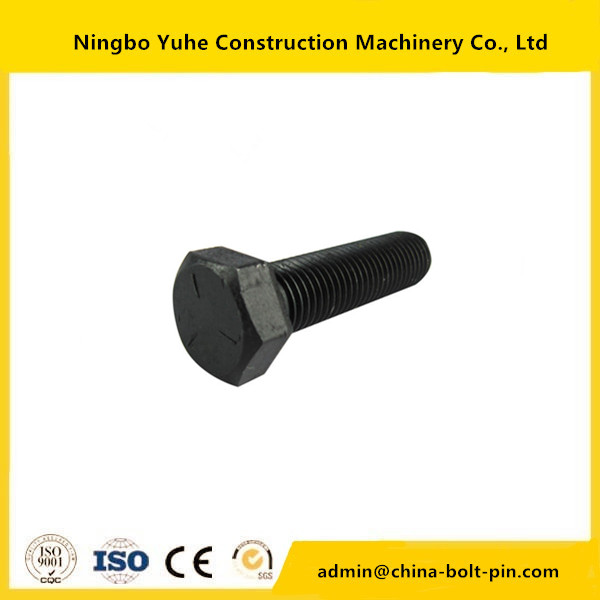
The fastener and the packing are priced together: our published cost stack puts steel at 30 to 40 percent of the piece price and heat treatment at 20 to 28 percent.
The packaging ladder: what actually protects a 12.9 grade bolt at sea
Export packing for track bolts is a ladder of layers, and each layer answers a different failure mode. The inner paper case keeps threads apart and stops the coating from rubbing; the wooden carton carries the stacking load and the labelling; the pallet gives the forwarder a forkable unit. Our published standard is a paper case inside and a wooden carton outside, and every package carries clear labelling with product details, batch numbers and compliance marks.
| Layer | Use | Specify | Prevents |
|---|---|---|---|
| Paper case | Every set, bolt separated from nut | Fixed quantity per case, part number and batch | Thread contact, coating abrasion, count errors |
| Wooden carton | Standard export pack | Carton size in mm, pieces per carton, gross weight in kg | Crushing in the stack, moisture ingress |
| Wooden crate | Heavy or mixed items | ISPM 15 treatment and mark, crate dimensions | Rejection at the port for untreated timber |
| Pallet and wrap | Every container load | Pallet spec, pallets per container, wrap turns | A load the stevedore cannot handle |
Wood packaging carries a regulatory mark, because unmarked wood has to be re-treated or refused at the border, so the mark belongs on the packing instruction. According to the International Plant Protection Convention, wood packaging material crossing borders must meet the ISPM 15 standard, which requires treatment and a mark showing the treatment type, the country of treatment and a unique number. The pallet is a separate specification: ISO 6780 covers flat pallets for intercontinental handling.
Palletizing math: from pieces per carton to pieces per container
Only you can build the stack, because no factory publishes its carton plan. We give you the packing data for the exact order, but the model below shows the arithmetic. Stated assumptions: a 600 x 400 x 300 mm export carton, 20 sets per carton, 4 cartons per layer and 4 layers, giving 320 sets on a 1200 x 1000 mm pallet, 11 pallets in a 20ft container and 23 in a 40ft high-cube, both sized per ISO 668, a 25 kg pallet and 3 percent for dunnage.
| Set weight | Pallet gross | 20ft pallets | 20ft sets | 20ft gross weight | 40ft pallets | 40ft sets |
|---|---|---|---|---|---|---|
| 0.5 kg | 185 kg | 11 | 3,520 | 2,096 kg (10% of payload) | 23 | 7,360 |
| 1.0 kg | 345 kg | 11 | 3,520 | 3,909 kg (18% of payload) | 23 | 7,360 |
| 2.0 kg | 665 kg | 11 | 3,520 | 7,534 kg (35% of payload) | 23 | 7,360 |
| 5.0 kg | 1,625 kg | 11 | 3,520 | 18,411 kg (86% of payload) | 15 | 4,800 |
Read that table twice, because the last row changes the commercial answer. At the light end a 20ft container is 10 to 18 percent of its usable payload, so the container is bought as space. At the heavy end the same 11 pallets are 86 percent of the payload, and a 40ft high-cube can no longer be filled with 23 pallets: at 5 kg per set only 15 fit, or 4,800 sets instead of 7,360. A volume-limited 20ft container holds about 20,600 kg, so the payload limit becomes the binding constraint above roughly 5.85 kg per set, and the biggest container is not automatically the cheapest per piece.
Sea-freight cost math: what a container actually costs per piece
Full container freight is a fixed price per box, so freight per piece is the container rate divided by the sets that fit in it: the packing plan is a freight decision. At the 3,520 sets per 20ft container above, a US$1,800 ocean rate is US$0.51 per set and a 40ft high-cube at US$2,600 across 7,360 sets is US$0.35. Read the lane price on the Freightos Baltic Index and the Shanghai Shipping Exchange index, then put your own numbers into the same division.
| Option | Chargeable basis | Illustrative cost | Cost per set |
|---|---|---|---|
| 20ft container at US$1,800 | Per container | US$1,800 | US$0.51 |
| 20ft container at US$2,400 | Per container | US$2,400 | US$0.68 |
| 40ft high-cube at US$2,600 | Per container | US$2,600 | US$0.35 |
| Shared load at US$120 per revenue ton | 3.79 revenue tons | US$455 | US$0.13 |
| Shared load plus US$350 of shipment charges | 3.79 tons plus fixed fees | US$805 | US$0.23 |
| Air cargo at US$5 per kg | 3,790 kg | US$18,950 | US$5.38 |
Shared load is often cheaper than a dedicated container for dense steel, because the weight billed is the same and the box is cheaper, so the fixed charges decide it. Track bolts are one of the few commodities where that runs in your favour: 3.79 t of steel occupies about 14 cubic metres, so the chargeable quantity is the weight. Shared load lands at US$0.23 per set against US$0.51 for a 20ft container, while double handling, the document charge and the destination fee are not in that number, so we model both options. The rate also moves between the quote and the sailing, because the steel and heat-treatment share of the piece price is set by our factory while the freight share is set by the market on sailing day, so the two must be quoted separately.
The landed-cost sheet between FOB and your warehouse
Landed cost is a short list of lines, because each one is priced by someone else, so each one needs an owner. A number without an owner is a number nobody has confirmed.
| Line | Who confirms it |
|---|---|
| Goods value, FOB Ningbo, packaging broken out | Our sales and engineering team, in writing |
| Export packing and palletization | Our packing list: carton size, pieces, gross weight |
| Ocean freight and inland haulage at both ends | Your forwarder, against the lane index |
| Destination charges: terminal handling, entry, delivery | Your broker and forwarder |
| Merchandise processing fee, 0.3464 percent ad valorem on a formal entry | Your broker, from the entry summary |
| Duty on HTSUS 7318.15.20, with a note pointing to 9903.90.09 | Your broker, against your classification |
| Country-of-origin marking and the Importer Security Filing | Your brand and your broker |
Three lines deserve attention. First, track bolts have their own published tariff line: subheading 7318.15.20 covers bolts entered with their nuts or washers together, statistical suffix 20.20 is published as “Track bolts”. Read it in the US Harmonized Tariff Schedule: the general column rate is free and column 2 is 3.5 percent, but the heading points to 9903.90.09 for additional duties, so the duty-free rate is not the whole duty.
Second, the Importer Security Filing forces the classification decision before you book the vessel. According to 19 CFR Part 149, the seller, buyer, importer of record and consignee data must be filed no later than 24 hours before lading, and the manufacturer, country of origin and HTSUS number no later than 24 hours before arrival at a US port, linked at line item level.
Third, country-of-origin marking is your obligation, not the factory’s. Under 19 CFR Part 134, every article of foreign origin must be marked conspicuously, legibly, indelibly and permanently so that the ultimate purchaser can see the English name of the country of origin. The CBP guidance for new importers adds that even when a broker files the entry, the importer of record stays responsible for the documentation and for all applicable duties and fees.
Five numbers to lock before you ask for a price
Ask for these five numbers before you ask for the price, because each one changes the price. Our published answer is minimum order quantity, lead time in days, pack size in pieces, carton weight in kg and pallet configuration, and we would add the gross weight of one packed pallet. The quality envelope travels with the packing: ask for a per-lot hardness report, a dimensional report and a material certificate traceable to the mill heat, with the inspection frequency in writing. The test methods are named and checkable: ISO 898-1 for the 10.9 and 12.9 property classes, ASTM F606/F606M for mechanical testing of threaded fasteners, and ASTM B117 for the salt spray envelope of your plating.
Where our own published pages disagree – and what to confirm before you pay
Our own pages disagree in several places, and we would rather you found that here than in a purchase order. We publish under two company names: “Ningbo Yuhe Construction Machinery Co., Ltd.” in the page titles and “Ningbo Digtech (YH) Machinery Co., Ltd.” in the body copy of the about page and the footers.
We also publish four lead times: 15 working days on the product pages, 5 to 7 days in stock and 15 to 20 days out of stock in the product FAQ, 20 to 30 days for mass production after deposit and final approval on the sourcing FAQ, and 30 to 45 days for a fully custom specification. Pin one number on the purchase order. Payment terms are published two ways as well – 30 percent deposit with the balance against the copy of the bill of lading, or 100 percent in advance below US$1,000 – and that matters for cash flow.
Two more published items need checking. The certificate page shows three images labelled ISO, SGS and test certificate without the certificate numbers, the issuing entity or the part numbers covered, so request the number and the covered model range. And the product page behind the track bolt product link carries an unfilled FOB range of US$0.5 to 9,999 per piece and a live header naming a different fastener, so the price field on that page is not a price.
Frequently asked questions
What is the minimum order quantity for track shoe bolts from China?
Our published minimum is 100 pieces per order, with working tiers of about 1,000 pieces for a production run and 5,000 to 10,000 for a bulk tier. A first order is usually limited by freight rather than by the factory minimum, because 100 sets is a fraction of a pallet and the container rate is charged whether the box is full or not.
How many track bolts fit in one 20ft container?
It depends on your carton plan and on the set weight. With our worked assumptions – 20 sets per carton, 16 cartons per pallet, 11 pallets per container – you get 3,520 sets, and the container reaches 10 percent of usable payload at 0.5 kg per set but 86 percent at 5 kg per set. Send us your part number and we will rebuild the table.
How much does sea freight add to the cost of a track bolt?
In the worked example, a 20ft container at an illustrative US$1,800 adds about US$0.51 per set, a 40ft high-cube at US$2,600 about US$0.35, and a shared load at US$120 per revenue ton plus US$350 of charges about US$0.23. These are illustrations with the rate built in, not quotes: the sailing-day lane rate decides the number.
Which US tariff line applies to track bolts and how is the duty calculated?
Track bolts are published under HTSUS 7318.15.20.20, a statistical suffix inside heading 7318.15.20 for bolts entered with their nuts or washers together, and reported in kilograms. The general column rate is free and column 2 is 3.5 percent, but the heading points to 9903.90.09 for additional duties, so ask your broker for the landed duty rate.
Can I ship a first track bolt order by shared load instead of a full container?
Often yes, because track bolts are dense and a 3.79 t shipment occupies only about 14 cubic metres, so the chargeable quantity in a weight-or-measure system is the weight. Expect consolidation, documentation and destination charges on top, and expect your packing to be protected against double handling. For a first order we would quote both.
About the author
Mr.chen is the Technical Director at Ningbo Yuhe Construction Machinery (Ningbo Digtech (YH) Machinery), a Ningbo-based undercarriage hardware and fastener manufacturer. Mr.chen has spent more than 30 years working with industrial fasteners, undercarriage hardware, and export production systems. He focuses on specification control, process stability, and practical cost reduction for global buyers.
Our production base covers more than 20,000 square metres in Hengxi Town, Yinzhou District, Ningbo, with 400 employees including 15 technicians and 2 senior engineers, and an engineering test centre for hardness, impact and ultrasonic testing. The factory sits 25 km from Ningbo Port. Check our company profile on the about page, our certificate page, or send a part number to our contact team.
Post time: Nov-27-2026