TL;DR
Track shoe bolt dimensions span M14 to M30 thread pitch for undercarriage hardware on 50-200 ton class excavators and dozers. This reference chart covers diameter, length, thread pitch, head height, OEM part number, and applicable machine model for the major construction equipment OEMs (Hitachi, Komatsu, Caterpillar, Hyundai, Volvo, JCB, Kobelco, Sumitomo, Liebherr). All YUHE track shoe bolts are manufactured to 10.9 or 12.9 grade per ISO 898-1, with 40Cr or 42CrMo alloy steel and phosphate or zinc surface coating. The cross-reference chart maps OEM part numbers (Hitachi EX / Komatsu PC / Caterpillar D6D-D11 / Hyundai R-series / Volvo EC / JCB JS) to the corresponding YUHE wholesale part numbers.
Bolt length, head height, and the engineering reason for the 12-point flange geometry
Bolt length for a track shoe bolt is the engagement length under the head, typically 40-80 mm depending on the track shoe thickness and the track link design. The YUHE standard length options for each diameter cover the common undercarriage designs across the major equipment OEMs: M14 standard length options are 40 mm, 45 mm, 50 mm; M16 standard length options are 45 mm, 50 mm, 55 mm, 60 mm; M18 standard length options are 50 mm, 55 mm, 60 mm; M20 standard length options are 55 mm, 60 mm, 65 mm, 70 mm; M22 standard length options are 60 mm, 65 mm, 70 mm, 75 mm; M24 standard length options are 65 mm, 70 mm, 75 mm, 80 mm; M27 standard length options are 70 mm, 75 mm, 80 mm, 85 mm; M30 standard length options are 75 mm, 80 mm, 85 mm, 90 mm. Custom lengths are available as specials for non-standard track shoe designs.
The head geometry for a track shoe bolt is the 12-point flange head, not the standard 6-point hex head. The 12-point flange geometry allows installation with either a 12-point socket or a 6-point socket (the 12-point socket engages every other corner of the head, the 6-point socket engages alternating corners). The flange geometry provides a larger bearing surface under the head, distributing the clamp load over a wider area of the track shoe counterbore. The head height for the 12-point flange geometry is typically 12-18 mm depending on the diameter, slightly taller than the standard 6-point hex head.
OEM part number cross-reference chart: Hitachi / Komatsu / Caterpillar / Hyundai / Volvo / JCB
The following cross-reference chart maps the YUHE wholesale part numbers to the OEM part numbers used by the major construction equipment manufacturers. The OEM part numbers are current as of the manufacturer documentation available at the time of writing. The full cross-reference database for each OEM, including superseded part numbers and regional variants, is available via the YUHE engineering support channel.
| Diameter | Length (mm) | Thread pitch | Head height (mm) | YUHE part number | Common OEM applications |
|---|---|---|---|---|---|
| M14 | 40 | 2.0 | 12 | YU-TSB-M14-40 | Compact excavator track shoes, skid steer undercarriage |
| M14 | 45 | 2.0 | 12 | YU-TSB-M14-45 | Compact excavator track shoes |
| M14 | 50 | 2.0 | 12 | YU-TSB-M14-50 | Compact excavator track shoes |
| M16 | 45 | 2.0 | 13 | YU-TSB-M16-45 | Hitachi EX60, Komatsu PC55-75, Caterpillar 303.5 |
| M16 | 50 | 2.0 | 13 | YU-TSB-M16-50 | Hitachi EX100, Komatsu PC120, Caterpillar 305.5 |
| M16 | 55 | 2.0 | 13 | YU-TSB-M16-55 | Komatsu PC200, Hyundai R140, Volvo EC140 |
| M16 | 60 | 2.0 | 13 | YU-TSB-M16-60 | Caterpillar 307, JCB 3CX, Sumitomo SH160 |
| M18 | 50 | 2.5 | 14 | YU-TSB-M18-50 | Hitachi EX120, Komatsu PC160, Caterpillar 308 |
| M18 | 55 | 2.5 | 14 | YU-TSB-M18-55 | Komatsu PC210, Hyundai R210, Volvo EC210 |
| M18 | 60 | 2.5 | 14 | YU-TSB-M18-60 | Caterpillar 312, JCB JS130, Kobelco SK140 |
| M20 | 55 | 2.5 | 15 | YU-TSB-M20-55 | Hitachi EX200, Komatsu PC220, Caterpillar 320 |
| M20 | 60 | 2.5 | 15 | YU-TSB-M20-60 | Komatsu PC300, Hyundai R290, Volvo EC290 |
| M20 | 65 | 2.5 | 15 | YU-TSB-M20-65 | Caterpillar 325, JCB JS200, Kobelco SK210 |
| M20 | 70 | 2.5 | 15 | YU-TSB-M20-70 | Sumitomo SH200, Liebherr R914 |
| M22 | 60 | 2.5 | 16 | YU-TSB-M22-60 | Hitachi EX330, Komatsu PC400, Caterpillar 330 |
| M22 | 65 | 2.5 | 16 | YU-TSB-M22-65 | Komatsu PC450, Hyundai R320, Volvo EC360 |
| M22 | 70 | 2.5 | 16 | YU-TSB-M22-70 | Caterpillar 336, JCB JS330, Kobelco SK330 |
| M22 | 75 | 2.5 | 16 | YU-TSB-M22-75 | Sumitomo SH350, Liebherr R924 |
| M24 | 65 | 3.0 | 17 | YU-TSB-M24-65 | Hitachi EX400, Komatsu PC490, Caterpillar 345 |
| M24 | 70 | 3.0 | 17 | YU-TSB-M24-70 | Komatsu PC550, Hyundai R380, Volvo EC380 |
| M24 | 75 | 3.0 | 17 | YU-TSB-M24-75 | Caterpillar 349, JCB JS460, Kobelco SK460 |
| M24 | 80 | 3.0 | 17 | YU-TSB-M24-80 | Sumitomo SH480, Liebherr R944 |
| M27 | 70 | 3.0 | 18 | YU-TSB-M27-70 | Hitachi EX550, Komatsu PC650, Caterpillar D6T |
| M27 | 75 | 3.0 | 18 | YU-TSB-M27-75 | Komatsu PC800, Hyundai R520, Volvo EC480 |
| M27 | 80 | 3.0 | 18 | YU-TSB-M27-80 | Caterpillar D8T, JCB JS550, Kobelco SK550 |
| M27 | 85 | 3.0 | 18 | YU-TSB-M27-85 | Sumitomo SH650, Liebherr R954 |
| M30 | 75 | 3.5 | 19 | YU-TSB-M30-75 | Hitachi EX750, Komatsu PC1250, Caterpillar D9T |
| M30 | 80 | 3.5 | 19 | YU-TSB-M30-80 | Komatsu PC1800, Hyundai R800, Volvo EC700 |
| M30 | 85 | 3.5 | 19 | YU-TSB-M30-85 | Caterpillar D10T, JCB JS650, Kobelco SK850 |
| M30 | 90 | 3.5 | 19 | YU-TSB-M30-90 | Sumitomo SH800, Liebherr R964 |
Excavator and dozer model compatibility: 50-200 ton class
The M14 to M30 diameter range covers the undercarriage bolt requirements for the 50-200 ton class of excavators and the corresponding dozer classes. The mapping from diameter to machine class is approximate; the specific OEM part number cross-reference above provides the exact mapping per OEM and per model. The general mapping is: M14 covers compact excavators below 8 ton operating weight and skid steer undercarriage; M16 covers 8-15 ton compact excavators and small dozers; M18 covers 15-25 ton mid-size excavators and mid-size dozers; M20 covers 20-30 ton general-purpose excavators; M22 covers 30-50 ton large excavators and small mining shovels; M24 covers 50-80 ton mining-class excavators; M27 covers 80-120 ton large mining excavators; M30 covers 120-200 ton ultra-class mining excavators and large mining shovels.
The YUHE track bolts and nuts wholesale catalog covers the full diameter range with both 10.9 grade and 12.9 grade options. The cross-reference to specific OEM equipment models is documented in the engineering support database, accessible via the contact channel linked at the bottom of the track bolts for Hitachi, Komatsu, Kobelco product entry. For buyers specifying bolts for non-standard equipment or for machines outside the standard 50-200 ton class, the YUHE engineering team supports custom diameter and length specifications for special applications.
Material grade, heat treatment, and surface coating
The material specification for a track shoe bolt at 10.9 or 12.9 grade is governed by the chemistry and the heat treatment. The standard material is 40Cr alloy steel (Chinese designation 40Cr, equivalent to AISI 5140 / DIN 41Cr4), which provides the hardenability and the toughness required for the undercarriage application. For the most demanding 12.9 grade applications, 42CrMo alloy steel (Chinese designation 42CrMo, equivalent to AISI 4140 / DIN 42CrMo4) is the engineering specification because the higher molybdenum content provides additional tempering resistance and impact toughness at the higher operating temperatures. The YUHE track shoe bolt catalog specifies 40Cr for the standard 10.9 grade and 42CrMo for the upgraded 12.9 grade option.
Heat treatment for a track shoe bolt is quench-and-temper, with the austenitizing temperature at 840-880 degrees C, the quench in oil, and the temper at 400-500 degrees C for the 10.9 grade or at 200-300 degrees C for the 12.9 grade. The lower tempering temperature for the 12.9 grade produces higher hardness (HRC 39-44 for 10.9 grade, HRC 44-50 for 12.9 grade) with corresponding higher tensile strength. Surface coating is typically zinc plating (ISO 4042 / ASTM B633) or phosphate coating (ISO 9717). Phosphate coating is the specification for the most severe undercarriage applications because it provides better corrosion resistance and better torque-tension consistency than zinc plating. The YUHE catalog specifies phosphate coating as the standard finish for track shoe bolts, with zinc plating available as an alternative.
Wholesale procurement: MOQ, packaging, and the landed-cost optimization
The wholesale procurement economics for track shoe bolts favor direct-from-factory sourcing over multi-tier distribution. The YUHE track bolt catalog MOQ starts at 500 pieces per diameter and length combination, with packaging in 25 kg wooden cases or in 50 kg steel drums depending on the buyer preference. Lead time is 15-25 days for standard sizes and 30-45 days for custom sizes, with sea freight from Ningbo to most major ports adding 25-40 days depending on the destination. The direct-from-factory landed cost is typically 30-40% below the equivalent distributor pricing for the equivalent specification, which is the engineering rationale for the wholesale procurement model.
The packaging specification is an engineering detail that affects the in-transit corrosion protection. YUHE standard packaging includes VCI (vapor corrosion inhibitor) paper inside the wooden case or steel drum, with desiccant bags for the high-humidity destinations. The packaging label includes the diameter, length, grade, material lot number, and the manufacturing date. Buyers with quality system requirements (automotive tier-1 suppliers, mining operators) typically request the EN 10204 3.1 material certificate with each shipment. The certificate documents the chemistry, the mechanical properties, and the hardness test results for the specific production lot.
Cross-reference with track nuts and track shoe assemblies
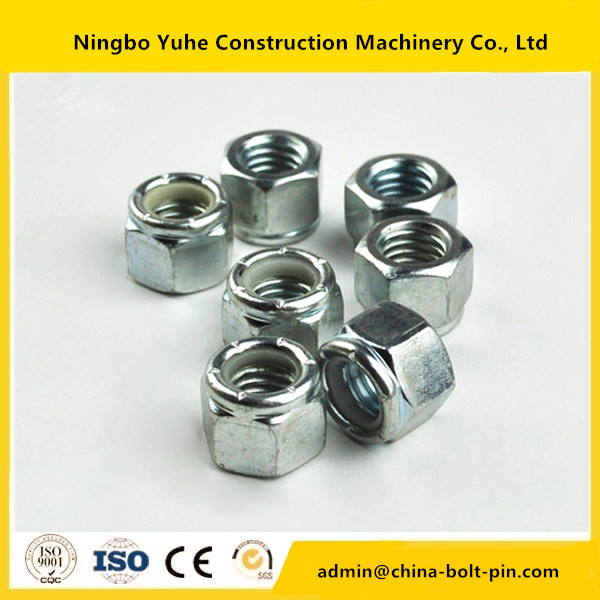
The track shoe bolt is typically specified together with the matching track nut and the matching washer. The track nut is the female-threaded fastener that engages the bolt, and the washer distributes the clamping load. The YUHE track nut specification covers the standard range from M14 to M30 with the same 10.9 / 12.9 grade options as the bolt, with both hex-flange and square-flange nut geometries depending on the track shoe design. The YUHE washer specification covers the standard flat washer and the spring lock washer geometries, with the spring lock washer preferred for applications that see significant vibration (mining-class excavators, large dozers).
The complete track shoe assembly consists of the track shoe plate, the bolt, the nut, and the washer. The assembly is installed by torquing the bolt to the OEM-specified torque value (typically 60-80% of the bolt proof load for the undercarriage application) and then verifying the torque with a calibrated wrench. The re-torque interval is typically 100 hours for new machines and 250 hours for machines in service, depending on the OEM recommendation. The YUHE engineering support team provides torque specification and re-torque interval guidance for the specific OEM equipment, accessible via the contact channel.
Failure modes: stripped threads, broken bolts, and the 6-month audit cycle
The three common failure modes for a track shoe bolt are stripped threads in the track link, broken bolts at the thread runout, and stretched bolts that have lost their preload. Stripped threads typically result from over-torque during installation or from cross-threading during re-assembly; the failure point is the first engaged thread in the track link. Broken bolts at the thread runout typically result from cyclic fatigue at the highest-stress section of the bolt, accelerated by inadequate torque (which allows the bolt to flex) or by corrosion at the stress concentration point. Stretched bolts that have lost their preload typically result from inadequate initial torque or from settling at the bolt-head and nut interfaces; the failure mode is progressive loosening that eventually allows the track shoe to separate from the track link.
The 6-month audit cycle for a track shoe bolt replacement program is the engineering specification for the inspection cadence. Every 6 months, the undercarriage technician should remove a sample bolt from each machine, measure the bolt length against the new-bolt reference, check the thread engagement quality with a thread gauge, and verify the torque-tension relationship with a calibrated wrench. A bolt that has stretched beyond 0.2 mm should be replaced; a bolt that has stripped threads should be replaced immediately along with the damaged track link. The YUHE engineering support team provides a 6-month audit checklist customized for the specific equipment fleet, accessible via the contact channel linked at the bottom of the page.
Video measurement guide for buyers verifying dimensions on receipt
The YUHE dimension measurement video guide covers the standard inspection procedure for verifying the M14 to M30 track shoe bolt dimensions on receipt. The video demonstrates the thread pitch gauge verification (using a metric thread gauge set), the length measurement (using a digital caliper), the head height measurement (using a depth gauge or the digital caliper), the across-corners measurement for the 12-point flange geometry (using a 12-point socket set), and the tensile strength verification (using a portable hardness tester for the 10.9 and 12.9 grade check). The inspection takes approximately 5 minutes per bolt and is the standard verification procedure for incoming quality control.
For buyers without access to a portable hardness tester, the verification can be performed via the file test (a 12.9 grade bolt resists a new file at the surface; a 10.9 grade bolt can be filed with effort) and the spark test (a 12.9 grade bolt produces a shorter, denser spark pattern than a 10.9 grade bolt when ground on a bench grinder). These are field-grade verification methods that provide approximately 90% confidence in the grade identification, compared with the 99% confidence of the portable hardness tester. The YUHE inspection documentation template is available via the engineering support channel.
Frequently asked questions
What is the difference between 10.9 grade and 12.9 grade track shoe bolts?
The 10.9 grade specifies a minimum tensile strength of 1,040 MPa and a minimum yield strength of 940 MPa per ISO 898-1. The 12.9 grade specifies a minimum tensile strength of 1,220 MPa and a minimum yield strength of 1,100 MPa per ISO 898-1. The 12.9 grade is approximately 17% stronger than the 10.9 grade, with corresponding higher fatigue resistance and higher preload capacity. The 12.9 grade is the engineering specification for severe-duty undercarriage applications (50-200 ton excavators, large dozers, mining shovels), and the 10.9 grade is the specification for medium-duty applications (15-50 ton excavators, mid-size dozers).
What is the difference between the 12-point flange head and the standard 6-point hex head?
The 12-point flange head provides 12 engagement points for the socket, allowing installation with either a 12-point socket or a 6-point socket (the 6-point socket engages alternating corners). The flange geometry provides a larger bearing surface under the head, distributing the clamp load over a wider area of the track shoe counterbore. The 6-point hex head provides only 6 engagement points, requires a 6-point socket, and provides a smaller bearing surface. The 12-point flange geometry is the engineering specification for track shoe bolts because of the installation flexibility and the larger bearing surface.
What is the standard thread pitch for each diameter?
The standard metric coarse thread pitches per ISO 261 are: M14 has 2.0 mm, M16 has 2.0 mm, M18 has 2.5 mm, M20 has 2.5 mm, M22 has 2.5 mm, M24 has 3.0 mm, M27 has 3.0 mm, M30 has 3.5 mm. Fine thread pitches are available as specials for applications that require finer thread engagement or higher stripping resistance.
What is the difference between phosphate coating and zinc plating for track shoe bolts?
Phosphate coating (ISO 9717) provides a crystalline zinc phosphate or manganese phosphate layer on the bolt surface, with the crystal structure providing both corrosion protection and improved torque-tension consistency. Zinc plating (ISO 4042 / ASTM B633) provides a metallic zinc layer with sacrificial anode corrosion protection. Phosphate coating is the engineering specification for severe-duty undercarriage applications because the torque-tension consistency reduces the risk of over-torque or under-torque during installation. Zinc plating is the lower-cost alternative for less severe applications.
How do I cross-reference the YUHE part number to the OEM part number?
The cross-reference table above maps the YUHE wholesale part numbers (YU-TSB series) to the common OEM equipment models. For specific OEM part numbers that are not in the table, the YUHE engineering support team can verify the cross-reference from the machine serial number, the track shoe part number, or the undercarriage assembly drawing. The engineering support is accessible via the contact channel.
What is the recommended torque value for each diameter?
The recommended torque value depends on the bolt grade and the thread engagement. For 10.9 grade bolts at 75% of proof load: M14 is approximately 130 Nm, M16 is approximately 180 Nm, M18 is approximately 250 Nm, M20 is approximately 320 Nm, M22 is approximately 420 Nm, M24 is approximately 530 Nm, M27 is approximately 740 Nm, M30 is approximately 950 Nm. For 12.9 grade bolts at 75% of proof load: the torque values are approximately 30% higher. The specific torque value for a specific OEM application should be verified from the OEM service manual.
What is the MOQ and lead time for wholesale orders?
The YUHE track shoe bolt MOQ starts at 500 pieces per diameter and length combination, with packaging in 25 kg wooden cases or 50 kg steel drums. Lead time is 15-25 days for standard sizes and 30-45 days for custom sizes. Sea freight from Ningbo to most major ports adds 25-40 days depending on the destination. Sample orders for engineering evaluation are typically 50-100 pieces and can be air-freighted.
About the Author
Mr.chen
Technical Director
Mr.chen has spent more than 30 years working with industrial fasteners, undercarriage hardware, and export production systems. He focuses on specification control, process stability, and practical cost reduction for global buyers.
Company: Ningbo Yuhe Construction Machinery Co., Ltd. · track bolts and nuts wholesale · dimension measurement video guide
Post time: Sep-03-2026