- Track bolt surface treatment selection is not a single-specification decision — it is a multi-dimensional trade-off across corrosion resistance, torque-friction coefficient, and hydrogen embrittlement risk.
- Zinc plating delivers the higher salt spray resistance (up to 600+ hours with zinc-flake topcoat) but exposes grade 12.9 and grade 10.9 track bolts to hydrogen embrittlement risk. Phosphate coating delivers the lower salt spray resistance (24 to 96 hours) but with the lower hydrogen embrittlement risk.
- For grade 12.9 and grade 10.9 plow bolts and undercarriage fasteners, the specification should require the hydrogen embrittlement relief (baking treatment per ASTM B850) and should favor mechanical zinc, zinc-flake, or phosphate coating over electrolytic zinc plating.
- For the full cutting edge plow bolt category and the 4F3665 plow bolt for excavator parts specification, the Yuhe catalog documents the surface treatment options per bolt grade.
- For the surface treatment selection framework, the bolt coating FAQ covers the per-coating technical specifications. The high-strength bolt blackening reference and the bolt plating process steps provide the additional context for the surface treatment selection.
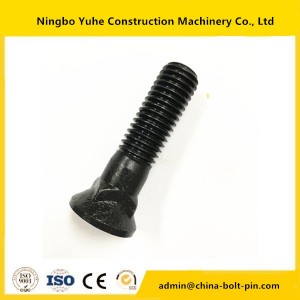
The Australian Mining OEM That Lost 17 Plow Bolts In One Quarter
Last autumn, an Australian mining equipment OEM contacted us with a track bolt failure problem that exposed the most underappreciated specification in the heavy equipment undercarriage fastener market. The OEM had been sourcing grade 12.9 plow bolts for the mining dump truck undercarriage, and the bolts were specified with the standard electrolytic zinc plating (white or yellow chromate) that the bolt industry had used for decades. Over the course of a single quarter, 17 of the plow bolts had failed in service — snapped at the first loaded engagement, with no visible deformation and no warning. The failure mode was catastrophic and the failure pattern was inconsistent with the typical mechanical overload.
When the OEM’s failure analysis team investigated the failure mode, the diagnosis was clear. The electrolytic zinc plating process had introduced atomic hydrogen into the grade 12.9 steel substrate through the acid pickling step at the beginning of the plating process. The high-strength steel’s martensitic microstructure trapped the hydrogen at the grain boundaries, and the trapped hydrogen reduced the fracture toughness to the point where the bolt could fail at the first loaded engagement. The failure mode is well known in the fastener industry as “hydrogen embrittlement” or “delayed fracture,” and the failure is most common in grade 10.9 and grade 12.9 bolts processed through acid-based plating.
The OEM switched the specification from electrolytic zinc plating to mechanical zinc plating with the baking treatment per ASTM B850, and the failure rate dropped to zero over the next two quarters. The mechanical zinc plating process does not use the acid pickling step, and the baking treatment drives the trapped hydrogen out of the steel substrate. The lesson was clear: the surface treatment selection for the high-strength track bolts is not a cosmetic specification. The selection is a safety-critical specification that determines whether the bolt survives the first loaded engagement.
Yuhe has been manufacturing track bolts, plow bolts, and the related undercarriage hardware for the heavy equipment market for years, and the surface treatment selection is one of the most common technical inquiries from OEM buyers. The phosphate vs zinc plating decision is the framework that our engineering team uses when working with heavy equipment OEMs on the track bolt specification. This article is the framework that we share with the OEM buyers who are evaluating the surface treatment selection for the grade 10.9 and grade 12.9 track bolts.
The Three Specification Dimensions: Corrosion, Torque, Hydrogen
The track bolt surface treatment selection focuses on three specification dimensions that determine the field performance. The three dimensions are the corrosion resistance, the torque-friction coefficient, and the hydrogen embrittlement risk. The three dimensions are not equally weighted in the surface treatment selection, and the optimal surface treatment is the surface treatment that delivers the best balance across the three dimensions for the specific bolt grade and the specific deployment environment.
The three dimensions are:
- Corrosion resistance — the salt spray resistance per ASTM B117, measured in hours before the red rust appears on the bolt surface.
- Torque-friction coefficient — the coefficient of friction between the bolt threads and the mating threads, which determines the torque-preload relationship in the assembly.
- Hydrogen embrittlement risk — the risk of delayed fracture from the hydrogen introduced during the acid-based plating process, which is the most severe failure mode for the grade 10.9 and grade 12.9 high-strength bolts.
The buyer that focuses on the corrosion resistance alone will end up with the surface treatment that delivers the highest salt spray resistance but may fail catastrophically due to the hydrogen embrittlement. The buyer that focuses on all three dimensions will end up with the surface treatment that delivers the best balance for the specific deployment environment.
| Surface Treatment | Salt Spray (ASTM B117) | Friction Coefficient | Hydrogen Embrittlement Risk |
|---|---|---|---|
| Manganese phosphate + oil | 24 to 72 hours | 0.10 to 0.15 | Low |
| Zinc phosphate + oil | 48 to 96 hours | 0.10 to 0.15 | Low |
| Electrolytic zinc + clear chromate | 48 to 96 hours | 0.10 to 0.18 | High (for grade 10.9/12.9) |
| Electrolytic zinc + yellow chromate | 96 to 240 hours | 0.10 to 0.18 | High (for grade 10.9/12.9) |
| Mechanical zinc (no acid pickling) | 96 to 240 hours | 0.10 to 0.16 | Low |
| Zinc-flake coating (Delta-Protekt, Geomet) | 240 to 600+ hours | 0.10 to 0.16 | Low (no acid, no hydrogen) |
The comparison table shows the trade-off between corrosion resistance and hydrogen embrittlement risk. The electrolytic zinc plating delivers the highest corrosion resistance in the standard surface treatment options, but the corrosion resistance comes with the highest hydrogen embrittlement risk for the grade 10.9 and grade 12.9 bolts. The phosphate coating and the zinc-flake coating deliver the lower hydrogen embrittlement risk with the lower corrosion resistance (phosphate) or the higher corrosion resistance (zinc-flake). The optimal surface treatment is the surface treatment that delivers the best balance for the specific bolt grade and the specific deployment environment.
Spec 1: The Corrosion Resistance (Salt Spray Hours)
The corrosion resistance, measured in hours of salt spray exposure per ASTM B117 before the red rust appears on the bolt surface, is the primary specification for the surface treatment selection in the outdoor deployment environment. The corrosion resistance determines the bolt’s service life in the wet, the muddy, and the chemically aggressive deployment environment, and the corrosion resistance determines the maintenance interval for the bolt replacement.
The salt spray resistance for the standard surface treatment options ranges from approximately 24 to 96 hours for the phosphate coating with the supplemental oil, to 48 to 240 hours for the electrolytic zinc plating with the chromate, to 240 to 600+ hours for the zinc-flake coating. The salt spray resistance is verified by the supplier at the ASTM B117 test, with the test data documented in the test report. The buyer should verify the salt spray resistance at the supplier’s reference installations, with the reference installation data providing the realistic salt spray resistance in the deployment environment.
The salt spray resistance is the primary parameter for the surface treatment comparison. The buyer that needs the higher salt spray resistance for the marine or the chemical deployment should specify the higher salt spray resistance, and the supplier comparison should be done at the higher salt spray resistance rather than at the entry-level specification.
It is important to note that the salt spray resistance in the laboratory (ASTM B117 neutral salt spray) does not directly translate to the field service life in the specific deployment environment. The field service life depends on the actual corrosion environment, the bolt loading, the bolt installation torque, and the maintenance practice. The salt spray resistance is a relative comparison between the surface treatment options, not an absolute prediction of the field service life.
Spec 2: The Torque-Friction Coefficient
The torque-friction coefficient, measured as the dimensionless coefficient of friction between the bolt threads and the mating threads, is the primary specification for the bolt assembly preload. The torque-friction coefficient determines the relationship between the applied torque and the resulting bolt preload, and the torque-friction coefficient determines the assembly accuracy and the consistency of the bolted joint.
The torque-friction coefficient for the standard surface treatment options ranges from approximately 0.10 to 0.15 for the phosphate coating with the supplemental oil, to 0.10 to 0.18 for the electrolytic zinc plating with the chromate, to 0.10 to 0.16 for the zinc-flake coating. The torque-friction coefficient is verified by the supplier at the test bench per the standard torque-preload test, with the test data documented in the test report. The buyer should verify the torque-friction coefficient at the supplier’s reference installations, with the reference installation data providing the realistic torque-preload relationship in the assembly.
The torque-friction coefficient is the primary parameter for the bolt assembly accuracy. The buyer that requires the higher assembly accuracy should specify the tighter torque-friction coefficient variation, and the supplier comparison should be done at the tighter coefficient variation rather than at the typical variation.
The torque-preload relationship per the bolt grade is documented in ISO 898 and ASTM A574, with the relationship calculated as T = K × D × P where T is the torque, K is the nut factor, D is the bolt diameter, and P is the preload. The nut factor K is calculated from the torque-friction coefficient and the thread geometry, and the buyer should specify the target preload and the target torque, with the supplier’s nut factor data providing the basis for the calculation.
Spec 3: The Hydrogen Embrittlement Risk (Critical For Grade 12.9 And Grade 10.9)
The hydrogen embrittlement risk is the most severe failure mode for the grade 10.9 and grade 12.9 track bolts, and the surface treatment selection must address the hydrogen embrittlement risk as the primary specification. The hydrogen embrittlement risk is the failure mode that the Australian mining OEM experienced with the 17 plow bolt failures, and the hydrogen embrittlement risk is the failure mode that the procurement specification must prevent.
The hydrogen embrittlement risk is the result of the acid pickling step in the electrolytic zinc plating process. The acid pickling removes the surface oxide from the steel substrate, but the acid also introduces atomic hydrogen into the steel. The high-strength steel’s martensitic microstructure traps the hydrogen at the grain boundaries, and the trapped hydrogen reduces the fracture toughness of the steel. The bolt can fail by delayed fracture — sometimes days or weeks after the plating process — at the first loaded engagement without any warning deformation.
The surface treatment options that avoid the hydrogen embrittlement risk include:
- Mechanical zinc plating — uses a mechanical impact process to deposit the zinc, without the acid pickling step. The mechanical zinc plating process does not introduce atomic hydrogen into the steel substrate, and the hydrogen embrittlement risk is eliminated.
- Zinc-flake coating (e.g., Delta-Protekt, Geomet) — uses a base coat and a top coat of zinc and aluminum flakes in a binder matrix. The zinc-flake coating process does not use the acid pickling step, and the hydrogen embrittlement risk is eliminated.
- Phosphate coating (manganese phosphate or zinc phosphate) — uses a chemical conversion process to deposit the phosphate crystals on the steel surface. The phosphate coating process does not use the acid pickling step, and the hydrogen embrittlement risk is low.
- Black oxide (blackening) — uses a chemical oxidation process to deposit the iron oxide on the steel surface. The black oxide process does not introduce atomic hydrogen into the steel, and the hydrogen embrittlement risk is low. The black oxide is the standard surface treatment for the high-strength bolts in the critical applications where the hydrogen embrittlement risk cannot be tolerated.
The baking treatment per ASTM B850 is the standard process for the hydrogen embrittlement relief, with the baking temperature in the 190 to 230 degrees C range and the baking duration in the 4 to 24 hour range. The baking treatment drives the trapped hydrogen out of the steel substrate, and the baking treatment is the standard process for the electrolytic zinc plating on the high-strength bolts. The buyer that requires the hydrogen embrittlement relief should specify the baking treatment per ASTM B850 in the procurement specification, and the supplier’s certificate of conformance should document the baking treatment per the specification.
The 12.9 Grade Track Bolt Surface Treatment Specification
The grade 12.9 track bolt is the highest strength class for the track bolt specification, and the grade 12.9 track bolt is the most sensitive to the hydrogen embrittlement risk. The grade 12.9 track bolt should be specified with the surface treatment that avoids the acid pickling step, and the grade 12.9 track bolt should be specified with the baking treatment per ASTM B850 as a redundant safeguard against the hydrogen embrittlement risk.
The 4F3650/4F3665 plow bolt series at the 4F3665 plow bolt product page is one of the standard grade 12.9 plow bolt specifications in the excavator and bulldozer undercarriage hardware. The 4F3665 series is specified with the mechanical zinc plating as the standard surface treatment, with the baking treatment per ASTM B850 as the standard process, and with the salt spray resistance in the 96 to 240 hour range per ASTM B117.
The grade 12.9 track bolt specification should include the following surface treatment requirements:
- Surface treatment: mechanical zinc plating, zinc-flake coating, or black oxide (avoid electrolytic zinc plating without the baking treatment)
- Hydrogen embrittlement relief: baking treatment per ASTM B850, 4 to 24 hours at 190 to 230 degrees C, with the baking treatment documented in the certificate of conformance
- Salt spray resistance: minimum 96 hours per ASTM B117 (for the mechanical zinc) or 240 hours (for the zinc-flake)
- Torque-friction coefficient: 0.10 to 0.16 with the variation within plus or minus 0.03
- Documentation: per-bolt test report, per-bolt certificate of conformance, per-bolt surface treatment specification
The grade 10.9 track bolt specification is similar to the grade 12.9 specification, with the lower strength class allowing the slightly higher surface treatment flexibility. The grade 10.9 track bolt is also sensitive to the hydrogen embrittlement risk, and the surface treatment selection should follow the same principles as the grade 12.9 selection.
The 8.8 Grade And Lower Track Bolt Surface Treatment Specification
The grade 8.8 and the lower grade track bolts are less sensitive to the hydrogen embrittlement risk, and the surface treatment selection for the lower grade track bolts is typically driven by the corrosion resistance and the cost considerations. The lower grade track bolts can be specified with the electrolytic zinc plating, with the standard baking treatment per ASTM B850, and the surface treatment selection is typically the cost-driven selection between the chromate treatment and the higher-cost topcoat treatment.
The lower grade track bolts in the less critical deployment environment (the indoor environment, the sheltered environment, the low-corrosion environment) can be specified with the standard electrolytic zinc plating with the clear chromate, with the salt spray resistance in the 48 to 96 hour range per ASTM B117. The lower grade track bolts in the more demanding deployment environment (the outdoor environment, the corrosive environment, the heavy industry environment) should be specified with the higher-cost surface treatment, with the salt spray resistance in the 96 to 240 hour range or higher.
The surface treatment selection for the lower grade track bolts is the cost-performance trade-off, with the higher-cost surface treatment delivering the higher salt spray resistance. The buyer that needs the higher salt spray resistance for the specific deployment should specify the higher-cost surface treatment, and the buyer that needs the lower salt spray resistance for the sheltered deployment can specify the lower-cost surface treatment.
The Plow Bolt Application: Surface Treatment Selection For The Cutting Edge Hardware
The plow bolt is the cutting edge hardware that connects the cutting edge to the moldboard or the bucket, and the plow bolt operates in the most aggressive wear and corrosion environment in the heavy equipment application. The plow bolt is subjected to the abrasive wear from the soil, the corrosive wear from the moisture and the chemicals in the soil, and the mechanical wear from the cutting edge impact. The surface treatment selection for the plow bolt must address the wear and the corrosion in addition to the hydrogen embrittlement risk.
The plow bolt application is dominated by the grade 8.8 and the grade 10.9 specifications, with the grade 12.9 used in the high-stress applications. The surface treatment selection for the grade 8.8 and the grade 10.9 plow bolts follows the standard surface treatment selection, with the mechanical zinc plating or the zinc-flake coating as the preferred surface treatments for the corrosion resistance, and with the baking treatment per ASTM B850 as the standard process for the hydrogen embrittlement relief.
The plow bolt specification at the cutting edge plow bolt category page documents the standard surface treatment options per bolt grade, with the standard specifications covering the grade 8.8, the grade 10.9, and the grade 12.9 plow bolts. The specific surface treatment recommendation is documented per the bolt grade and the deployment environment, with the procurement specification matching the deployment environment to the surface treatment option.
The Procurement Specification: How To Document The Surface Treatment Selection
The procurement specification for the track bolt surface treatment should document the surface treatment selection with the specific parameters per the deployment environment. The procurement specification should include the surface treatment type, the salt spray resistance requirement, the torque-friction coefficient requirement, the hydrogen embrittlement relief requirement, and the documentation requirement per the bolt grade and the deployment environment.
The procurement specification should follow the standard format that includes the bolt grade, the dimensional specification, the material specification, the mechanical property specification, the surface treatment specification, the hydrogen embrittlement relief specification, the documentation specification, and the test report specification. The specification should be reviewed against the standard specifications (ISO 898 for the bolt grade, ISO 3506 for the stainless steel bolt, ASTM A574 for the high-strength bolt, ASTM B850 for the hydrogen embrittlement relief) to ensure the specification is consistent with the industry standard.
The procurement specification should also include the supplier qualification requirements, with the supplier’s quality system certification (typically ISO 9001), the supplier’s process capability documentation, and the supplier’s reference installation data. The supplier qualification is the basis for the supplier’s ability to deliver the surface treatment specification consistently across the procurement volume.
For the bolt coating FAQ reference, the additional technical details on the per-coating specifications are documented per the typical question and answer. The high-strength bolt blackening reference documents the engineering rationale for the blackening selection for the high-strength bolts, and the bolt plating process steps documents the standard process flow for the bolt plating.
The Standards And Reference Framework
The track bolt surface treatment standards framework includes the international standards for the bolt specification (ISO 898 for the bolt grade, ISO 3506 for the stainless steel bolt, and the equivalent national standards), the regional standards for the surface treatment (ASTM B117 for the salt spray resistance, ASTM B633 for the zinc plating, ASTM B850 for the hydrogen embrittlement relief, ASTM A574 for the high-strength bolt, and the equivalent national standards), and the manufacturer-specific standards that document the specific surface treatment specifications.
The SAE International provides the technical standards for the bolt specification, with the SAE J429 standard for the bolt grade and the SAE J1199 standard for the surface treatment. The BSI Group provides the European standards for the bolt specification, with the BS EN 14399 standard for the high-strength bolt and the BS EN ISO 4042 standard for the surface treatment. The DIN standards portal provides the German national standards for the bolt specification, with the DIN 933 standard for the hex bolt and the DIN 267-9 standard for the surface treatment.
The ASME standards provide the mechanical engineering standards for the bolt assembly and the bolted joint design, with the ASME B18.3 standard for the hex bolt and the ASME B18.24 standard for the bolt identification. The Stainless Steel Information Center provides the technical reference for the stainless steel fastener, with the educational resources on the surface treatment and the corrosion resistance. The International Molybdenum Association provides the material science reference for the high-strength steel substrate, with the technical data on the alloy composition and the heat treatment.
Closing Recommendation: Avoid Electrolytic Zinc On Grade 12.9 And Grade 10.9
For OEM buyers specifying the track bolt surface treatment for the heavy equipment undercarriage hardware, the recommendation is to use the three-dimension comparison table as the working document, with the hydrogen embrittlement risk as the primary selection criterion for the grade 10.9 and grade 12.9 bolts. The electrolytic zinc plating should be avoided for the grade 10.9 and grade 12.9 bolts, and the mechanical zinc plating, the zinc-flake coating, or the blackening should be specified instead.
For the cutting edge plow bolt category and the 4F3665 plow bolt for excavator parts specification, the Yuhe catalog documents the surface treatment options per bolt grade, with the mechanical zinc plating and the blackening as the standard surface treatments for the grade 10.9 and grade 12.9 plow bolts. The bolt coating FAQ covers the additional technical details on the per-coating specifications, and the Yuhe engineering team can provide the application-specific guidance for the specific procurement.
For buyers who want to discuss the surface treatment selection for a specific track bolt procurement, the Yuhe engineering team is available for technical consultation. The standard response time is within 24 hours, with the per-spec documentation and the surface treatment recommendation available within the typical heavy equipment fastener procurement timeline.
About the Author: Mr. Chen is the Technical Director at Ningbo Yuhe Construction Machinery Co., Ltd., with 30+ years of experience in industrial fasteners, undercarriage hardware, and export production systems. He focuses on specification control, process stability, and practical cost reduction for global buyers, and has spent his career working on the track bolt, plow bolt, and cutting edge hardware specifications for the heavy equipment OEM market.
Post time: Aug-20-2026