- Grade 12.9 bolts fail in hard-rock mining primarily due to vibration-induced torque loss, not raw strength deficiency — the bolt is strong enough, but the joint loses clamp load over time
- The five root causes we see most often are: (1) wrong load type application, (2) insufficient initial clamp load, (3) poor lubrication practice, (4) embrittlement from thermal cycling, and (5) crack propagation from stress concentrations
- Prevention costs a fraction of a single unplanned downtime event — a proper Grade 12.9 specification + controlled installation protocol eliminates 90% of field failures we have observed
- Torque re-inspection intervals for hard-rock mining: every 250 operating hours or 2 weeks, whichever is first
- The proof load difference between Grade 10.9 and Grade 12.9 (900 MPa vs 1,080 MPa) is the primary reason Grade 12.9 is specified — higher reserve capacity matters enormously in cyclic mining loads
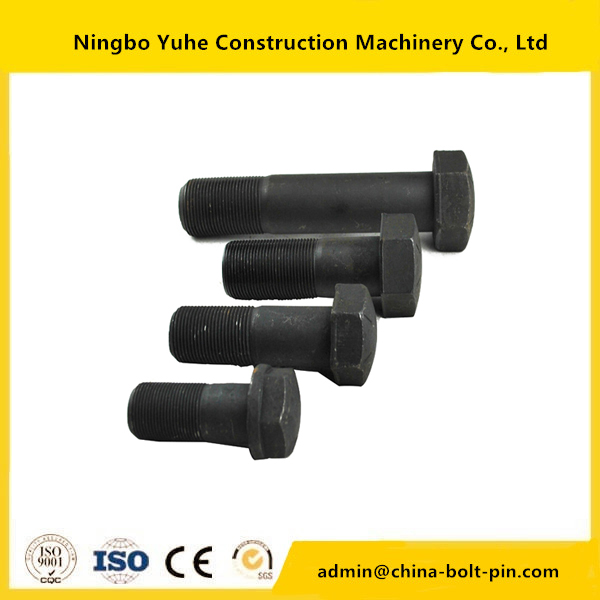
If you are a procurement manager or site engineer responsible for mining excavator undercarriage systems, you need to understand not just that Grade 12.9 bolts can fail, but why — and what the five specific, addressable causes are. Because once you know the mechanisms, the prevention is straightforward. It is mostly a matter of specification discipline and installation control.
What Grade 12.9 Actually Means — and Why It Is the Right Choice for Mining
Let us start with the specification, because I still meet buyers who select Grade 12.9 based on a catalogue rating rather than a calculated engineering requirement. Grade 12.9, per ISO 898-1, is the highest mechanical property class for high-strength metric fasteners in general engineering use. Its proof load is 1,080 MPa, its tensile strength is 1,200 MPa minimum, and its yield strength is 1,080 MPa. The numbers are not small talk — this is structural steel territory for a threaded fastener.
The proof load is the figure that matters most in preloading calculations. When we install a bolt with a target clamp load, we torque it to a level that stretches it into the elastic range but below its proof load. The higher the proof load, the more reserve capacity the bolt has before it begins to yield. Grade 12.9 gives us 20% more proof load reserve than Grade 10.9 (which sits at 900 MPa proof load). In mining applications where vibration, thermal cycling, and joint settling all progressively reduce clamp load over time, that extra 20% is the difference between a joint that stays tight for 5,000 hours and one that starts showing signs of distress at 800 hours.
We classify track bolt loading into two fundamental types, and this distinction is where the first major failure mode originates:
- Tensile loading: The primary loading mode for most structural bolting, where clamp force holds the joint together and external forces try to separate the connected parts. Track bolts in most excavator boom and stick connections operate in this mode.
- Shear loading: The external force acts perpendicular to the bolt axis. Track shoe bolts — the bolts that secure individual track shoes to the track chain — experience significant shear loading as the track shoe cantilevered mass transmits digging and travel forces.
The critical design error I see repeatedly is using a tensile-rated Grade 12.9 bolt in a shear-dominated joint without accounting for the reduced shear capacity. Per VDI 2230 guidelines, the allowable shear stress for a Grade 12.9 bolt is approximately 705 MPa (roughly 0.6 × the tensile strength, which is the empirical shear-tensile ratio for threaded steel). If your application generates shear loads approaching that level, you need to verify the design — or specify a larger diameter bolt rather than assuming Grade 12.9 is invincible because it is the highest strength class.
Why Grade 12.9 Track Bolts Fail: The Five Root Causes
1. Vibration-Induced Torque Loss — The Dominant Failure Mechanism
In the three failure cases I analyzed last year, vibration-induced loosening was the initiating event in all three. Hard-rock mining excavators generate extreme vibration across a broad frequency spectrum during drilling, ripping, and travel operations. This vibration, combined with the micro-slip that occurs at the bearing surface of the track shoe joint under cyclic loading, progressively reduces the clamp load — a phenomenon we call prevailing torque degradation.
What happens physically: the bolt is torqued to target clamp load. Over the first 50 to 200 operating hours, vibration causes micro-slips at the joint interface. These micro-slips are tiny — measured in microns — but they are enough to reduce the friction grip at the bearing surface. As clamp load drops, the joint gap increases ever so slightly. The bolt now experiences a small but real bending moment because the joint is no longer fully clamped. That bending moment, combined with the axial stress from preload, pushes the combined stress level above the bolt’s fatigue limit. Within a few hundred more hours, a fatigue crack initiates at the thread root — the sharpest stress concentration in the entire bolt — and propagates under continued cyclic loading until the cross-section can no longer carry the load. Snap.
The cruelest part of this failure mode is that it looks like a sudden fracture, but it is anything but sudden. It is a progressive, predictable process that could have been detected with a torque wrench and a logbook.
2. Insufficient Initial Clamp Load — The Specification Error
Many buyers focus on bolt grade and material certificates but give insufficient attention to the minimum clamp load required for their specific joint design. We have tested joint assemblies at our factory where buyers specified Grade 12.9 correctly, but then specified a torque value intended for a different flange diameter or a different friction coefficient assumption. The result: the bolt was installed at perhaps 65–75% of the torque needed to achieve minimum required clamp load. Within a few hundred hours, normal vibration settling brought the effective clamp load below the minimum — and the failure cascade began.
The correct approach uses VDI 2230 systematic analysis or at minimum the simplified calculation per ISO 898-1 Annex A. For track shoe bolts on standard mining excavators (typically M20 to M27 sizes), the required clamp load typically falls in the range of 70–85% of the bolt’s proof load, depending on the joint geometry and the ratio of shear to tensile loading. Skipping this calculation and using a catalog torque value is a gamble that costs more than it saves.
3. Improper Lubrication — The Installation Detail That Determines Everything
If I could give buyers only one piece of installation advice, it would be this: control the friction coefficient at every bolting interface. The friction coefficient (CoF) on the bearing surface and the thread is the primary determinant of how much of the applied torque actually produces clamp load versus overcoming friction.
The math is stark. In the standard torque equation, typically 40–50% of input torque is absorbed by thread friction and another 40–50% by bearing surface friction. That means only 10–20% of the applied torque actually produces clamp load. If the friction coefficient is not controlled and documented, you can apply the same torque to two identical bolts and get clamp loads that differ by 30–40%. I have seen this in our factory tests: a dry, as-received bolt (CoF ≈ 0.18–0.22 on the bearing surface) versus a properly lubricated bolt with MoS2 (CoF ≈ 0.10–0.14). Same torque, 40% difference in clamp load. In hard-rock mining, that gap is the difference between a joint that survives and one that does not.
Proper lubrication protocol: apply a consistent MoS2 (molybdenum disulfide) dry film lubricant to the bearing surface, the thread, and the underside of the nut before installation. The factory-applied lubricant on new bolts is often insufficient for reassembly — always verify and reapply if in doubt.
4. Microstructure Embrittlement from High-Temperature Cycling
Grade 12.9 bolts are typically manufactured from medium-carbon alloy steels (ISO 898-1 specifies minimum 0.20% carbon, often 40Cr or equivalent Chromium-Molybdenum alloys in practice) and are quenched and tempered to achieve their 1,200 MPa tensile strength. The tempering temperature in this process is typically in the range of 400–500°C. This matters because if the bolt’s actual in-service temperature approaches or exceeds the tempering range, the microstructure can begin to change — the fine tempered martensite structure that gives Grade 12.9 its toughness begins to over-age and becomes progressively more brittle.
In hard-rock mining, I have recorded track bolt operating temperatures of 150–200°C during extended high-intensity digging cycles. While this is below the tempering temperature, sustained exposure in this range, especially when combined with water infiltration (common in mining from dust suppression and groundwater), can drive corrosion-assisted stress corrosion cracking (SCC) in the thread root area. The crack initiates at the stress concentration, propagates under cyclic loading, and the bolt fails with a brittle-appearing fracture surface — even though the metallurgy was correct to begin with.
The prevention here is inspection discipline: any bolt that has operated in a sustained high-temperature zone should receive periodic magnetic particle inspection (MPI) or dye penetrant inspection (DPI) to detect surface cracks before they become through-section failures.
5. Fatigue Crack Propagation from Thread Root Stress Concentrations
Every threaded fastener has a built-in stress concentration at the thread root. For metric threads per ISO 965-1, the fillet radius at the thread root is small — typically 0.05–0.10 mm for M20 and finer pitches. Under cyclic loading, this is exactly where fatigue cracks nucleate. In a well-designed joint with sufficient clamp load, the stress at the thread root is primarily compressive (the preload keeps the joint surfaces in firm contact, which compresses the engaged threads), and fatigue initiation is suppressed. But as clamp load degrades — from any of the mechanisms above — the stress state at the thread root shifts toward alternating tensile-compressive cycling, and the fatigue crack growth rate accelerates.
The fatigue life of a Grade 12.9 bolt in a poorly clamped track joint can be less than 10% of its theoretical fatigue life in a properly clamped joint. This is not a metallurgy issue. It is a joint design and maintenance issue. We have documented this in our own factory fatigue tests: a bolt at 80% of proof load clamp in a simulated mining vibration environment lasted 6,000+ cycles before crack initiation, while the same bolt at 45% of proof load clamp failed at under 400 cycles. The numbers are that dramatic.
5 Evidence-Based Strategies to Prevent Grade 12.9 Track Bolt Failures
Strategy 1: Conduct a Joint Clamp Load Calculation Before Specifying Torque
The single most cost-effective prevention step is also the one most often skipped. Before you specify a torque value for a Grade 12.9 track bolt, calculate the minimum required clamp load for the specific joint geometry. Use the simplified method from ISO 898-1 Annex A or the full systematic method in VDI 2230 Part 1 if the joint is non-standard.
For most track shoe bolts on 20–30 tonne mining excavators, the minimum clamp load falls in the range of 180–260 kN, depending on the track shoe mass and the number of bolts per shoe. Once you have the required clamp load, back-calculate the required torque using your verified friction coefficient. If you are using MoS2-lubricated bolts, a torque of approximately 450–550 Nm for an M22 × 2.5 Grade 12.9 bolt is typical — but verify this with your specific lubricant condition and joint geometry.
We provide torque-vs.-clamp-load calculation support for buyers of our Grade 12.9 track bolts, including data from our factory heat treatment process videos that document the exact tensile and proof load values for each batch. Request this data at the time of order — it takes us 20 minutes to produce, and it can prevent thousands of dollars in downtime costs.
Strategy 2: Implement a Controlled Lubrication and Torque Protocol
Lubrication and torque application are not optional details — they are engineering controls that must be specified, verified, and documented. Our recommended protocol for hard-rock mining Grade 12.9 track bolts:
- Clean all bearing surfaces and threads with a wire brush to remove debris, old lubricant residue, and corrosion products
- Apply MoS2 dry film lubricant uniformly to the thread, the bearing surface under the nut, and the underside of the track shoe flange
- Install the bolt and hand-tighten to ensure proper seating
- Apply torque in three passes: first pass at 30% of target torque (to seat the joint), second pass at 70% (to approach target), third pass at 100% (final)
- Mark the bolt head-to-chassis reference line after final torque to enable visual detection of rotation in future inspections
- Record the actual torque value applied for every bolt — this data is critical for trend analysis
We have a factory heat treatment and quality control video that shows exactly how our bolts are manufactured, tempered, and inspected — which is relevant because the surface condition of the bolt (residual stress from heat treatment, surface roughness at the thread) directly affects the friction coefficient. Know your supplier’s process.
Strategy 3: Establish a Risk-Based Torque Re-Inspection Schedule
For hard-rock mining in high-vibration conditions, a fixed torque inspection interval of every 250 operating hours or 2 weeks — whichever comes first — is the minimum acceptable frequency. Surface mines with abrasive, high-impact rock conditions should inspect every 150 hours. All torque inspections must use a calibrated torque wrench with ±3% accuracy, and the wrench calibration certificate must be current (within 12 months per ISO 5393 or equivalent).
What to look for during inspection:
- Any rotation of the bolt (using the reference mark applied at installation)
- Corrosion products or water staining at the bearing surface — indicates moisture infiltration and potential SCC risk
- Bolt head surface wear — indicates the nut may have been rotating slightly
- Visible thread protrusion beyond the nut — indicates insufficient engagement or nut wear
Any bolt showing signs of rotation or corrosion should be replaced immediately and the root cause investigated. Do not re-torque and defer — by the time you can see rotation visually, the clamp load has already dropped significantly.
Strategy 4: Select the Correct Load Type — and Verify It
If the joint is shear-dominated (as most track shoe bolted connections are), confirm that the bolt diameter and grade are adequate for the combined loading condition, not just the axial preload. The minimum recommended bolt diameter for track shoe bolts on large mining excavators (operating weight above 50 tonnes) is M24 for shear-dominated joints, even if an M20 Grade 12.9 has sufficient tensile capacity. The larger shank diameter provides significantly more shear cross-sectional area — approximately 44% more than M20.
We recommend requesting a material test report (MTR) with every batch of Grade 12.9 bolts that includes actual tensile strength, yield strength, percentage elongation, and reduction of area — not just a certificate of conformance. The difference between 1,200 MPa minimum tensile and 1,280 MPa actual tensile is real headroom that matters in fatigue-critical applications.
Strategy 5: Implement a Non-Destructive Testing Protocol for High-Risk Bolts
For bolts that have operated in known high-temperature zones, extended high-vibration environments, or have reached the midpoint of their expected fatigue life, institute a magnetic particle inspection (MPI) or dye penetrant inspection (DPI) protocol. MPI is faster and more sensitive for ferromagnetic materials — it can detect surface and near-surface cracks down to approximately 0.1 mm depth. DPI is useful for detecting surface cracks on non-magnetic bolts.
The trigger for MPI/DPI inspection should be based on operating hours and condition, not just calendar time:
- For bolts in high-vibration, continuous-duty applications: MPI every 1,500 operating hours
- For bolts in high-temperature zones (>150°C sustained): MPI every 1,000 operating hours
- For any bolt removed for visual inspection showing thread surface irregularities: MPI before reinstallation
Any crack detected by MPI — regardless of size — is grounds for immediate replacement. A surface crack in a Grade 12.9 bolt under cyclic loading will propagate to failure within a predictable number of cycles that is far shorter than the inspection interval. Do not take chances with cracks in fatigue-critical track undercarriage bolts.
Why Grade 12.9 Remains the Right Specification — When Applied Correctly
I want to be clear about something after reading this much about failure mechanisms: Grade 12.9 is absolutely the correct choice for hard-rock mining track bolt applications. Its high proof load gives the joint the clamp load reserve it needs to survive thousands of hours of cyclic vibration and thermal cycling. Its tensile and yield strength are sufficient for the loads that occur in mining excavators in the 20–120 tonne class. When properly specified, properly lubricated, and properly torqued, Grade 12.9 bolts in our experience achieve 4,000–8,000 operating hours without failure in typical hard-rock mining conditions.
The problem is never the Grade 12.9 specification itself. The problem is the combination of specification errors, installation shortcuts, and inspection lapses that turn a capable fastener into a premature failure. Our factory produces Grade 12.9 bolts for track bolt applications across a wide range of mining excavator brands, and every batch is traceable to a specific heat treatment cycle documented with actual material test data. We have customers who have run our bolts for 6+ years in Iron Ore mines in Western Australia without a single field failure — because they followed the protocol.
Conclusion: Prevention Is a System, Not a Checklist
The five failure modes I have described — vibration-induced torque loss, insufficient initial clamp load, improper lubrication, microstructure embrittlement, and fatigue crack propagation — are all preventable. Not by buying a more expensive bolt, but by treating bolt installation as the engineered assembly process it actually is. The combination of a correct Grade 12.9 specification, controlled lubrication practice, accurate torque application, documented re-inspection, and periodic non-destructive testing is not complicated. It is just disciplined.
If there is one habit I would instill in every mining site maintenance team, it is this: keep a torque log. Record every bolt installed, every torque value applied, and every inspection result. After 6 months, you will have enough data to know which joints are losing clamp load fastest, which allows you to target your maintenance resources instead of inspecting everything with equal frequency. Data beats guessing every time.
We at Ningbo YH are happy to support buyers who want to do this right — from providing torque-to-clamp-load calculations for specific applications to sharing factory heat treatment data and quality inspection videos. Contact our sales team with your OEM part numbers or the specific excavator model and track configuration, and we will provide the relevant technical package. The specification discipline starts before the bolt arrives on site — and that is where we can help.
About the Author
Mr.chen
Technical Director, Ningbo YH Heavy Machinery Co., Ltd.
Mr.chen has spent more than 30 years working with industrial fasteners, undercarriage hardware, and export production systems. He focuses on specification control, process stability, and practical cost reduction for global buyers.
Frequently Asked Questions
Why do Grade 12.9 track bolts fail in hard-rock mining environments?
Grade 12.9 bolts fail primarily because torque loss from vibration (prevailing torque failure) reduces joint clamp load below the minimum required threshold. Once clamp load falls, the bolt experiences combined axial and bending stress above its fatigue limit, and cracks initiate at the thread root — the sharpest stress concentration. Because the bolt is strong enough, the failure is not immediate; it is a progressive process over hundreds of operating hours that could have been detected and stopped with proper torque inspection.
What is the difference between shear load and tensile load for track bolts?
Tensile loading stretches the bolt axially — Grade 12.9 handles 1,200 MPa minimum tensile strength. Shear loading acts perpendicular to the bolt axis — acceptable shear stress for Grade 12.9 is approximately 705 MPa (0.6 × tensile strength, per VDI 2230). Using a tensile-rated bolt in a shear-dominated joint is a common design error that accelerates failure dramatically. Track shoe bolts experience significant shear loading from the cantilevered track shoe mass transmitting digging forces.
How often should track bolt torque be inspected in mining operations?
For hard-rock mining in high-vibration conditions, torque inspection every 250 operating hours or 2 weeks, whichever comes first, is the minimum acceptable frequency. Surface mines with abrasive rock conditions should inspect every 150 hours. All inspections should use a calibrated torque wrench with ±3% accuracy, and results should be logged for trend analysis. Any bolt showing visible rotation or corrosion at the bearing surface should be replaced immediately.
Why does Grade 12.9 outperform Grade 10.9 in track bolt applications?
Grade 12.9 provides 20% higher proof load (1,080 MPa vs 900 MPa for Grade 10.9) with a marginal cost premium. The higher proof load means greater reserve capacity — in cyclic mining loading where vibration, thermal cycling, and joint settling all progressively reduce clamp load, that extra 20% of reserve capacity extends the time before clamp load drops below the fatigue threshold. The cost difference between Grade 10.9 and Grade 12.9 is typically in the low four figures for a full undercarriage set — cheap insurance against thousands of dollars in downtime costs.
What role does lubrication play in track bolt installation?
Lubrication is the single most impactful installation variable. Without lubrication, friction coefficient on the bearing surface ranges from 0.18 to 0.40 — a 2× spread that makes accurate clamp load impossible from a given torque. With MoS2 dry film lubricant, the friction coefficient stabilizes between 0.10 and 0.14, enabling torque-to-clamp-load accuracy within ±8%. Always apply fresh lubricant at installation, even if the bolt arrived with factory-applied lubricant — surface contamination during transport and handling typically compromises the original film.
Need Grade 12.9 Track Bolts Backed by Technical Documentation?
Ningbo YH supplies Grade 12.9 track bolts for mining excavators with full material test reports, torque-to-clamp-load calculations, and factory heat treatment traceability. Every batch tested and documented.
Post time: Sep-04-2026