For a Komatsu PC200-class bucket tooth pin, an OEM-spec part carries a 25 to 40 percent price premium over a quality-controlled aftermarket equivalent — and the gap is real, but it is not always what it appears. The right answer depends on the part class, the machine’s warranty status, and the buyer’s ability to inspect at goods-in, not on the OEM badge alone. Thirty years of writing fastener specifications have taught us that the OEM-vs-aftermarket decision is rarely a binary one; it is a per-class matrix.
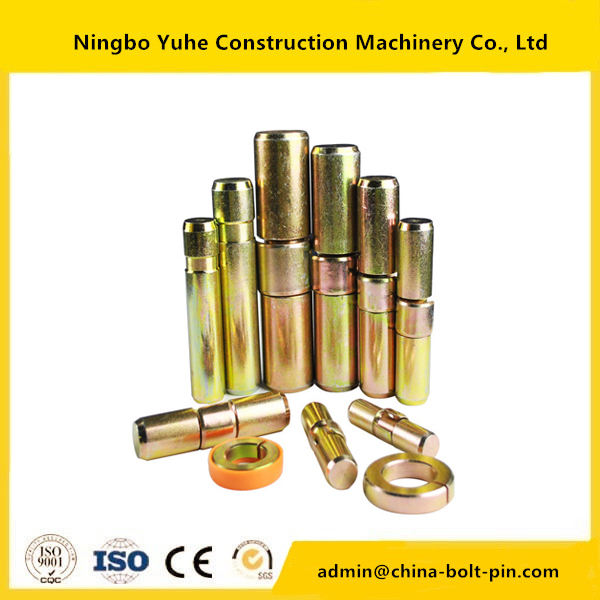
Where the 30% Actually Goes
The 25 to 40 percent OEM premium is the headline number, but it does not break out as one cost. It is the sum of four contributors:
| Contributor | Typical share of the premium | What it buys |
|---|---|---|
| OEM brand and packaging | 5 to 10 percent | Recognisable logo, sealed packaging, traceability documents |
| Warranty footprint | 5 to 10 percent | Warranty claim honoured by the OEM distributor worldwide |
| Logistics and stocking | 5 to 10 percent | Distributor inventory within 24 to 48 hours of any major port |
| Material certification and audit trail | 10 to 15 percent | Per-batch traceability, OEM-validated heat-treatment, audited forging process |
For a quality-controlled aftermarket supplier, the first three contributors shrink to near-zero; the fourth contributor is what the buyer is paying for when the buyer pays the OEM premium. The procurement question is whether the buyer’s in-house inspection can replace the OEM’s audited heat-treatment and traceability chain. On most large fleets, the answer is no, and the OEM premium is the price of audit. On price-sensitive aftermarket channels, the answer is yes, and the aftermarket price is the right call.
The Three Hidden Failure Modes the 30% Premium Buys Against
The 30% premium buys protection against three failure modes that the aftermarket price does not. None of the three are visible in a catalogue line; all three are visible only in service, and only after the pin has been in the machine for a few hundred hours. Understanding the three failure modes is what separates a per-class decision from a per-decade procurement reflex.
Failure mode 1: Heat-treatment consistency. A through-hardened pin to the OEM’s HRC 38 to 45 range requires a controlled austenitising temperature, a controlled quench, and a controlled temper. The OEM’s published datasheet is the result of thousands of heats; the aftermarket mill’s published datasheet is the result of fewer. The aftermarket equivalent that reads at HRC 35 in service will deform; the one that reads at HRC 48 will snap. Both look identical to the eye on the receiving dock. The ISO 898-1:2013 mechanical-properties reference sets the test method, and a per-batch test report aligned to ISO 898-1 is the audit trail that confirms the heat-treatment was actually performed.
Failure mode 2: Forging-to-finish dimensional control. A pin that measures correctly on diameter and length but runs oversized on the chamfer will not seat in the mating bore on installation. The operator forces it home with a hammer, the chamfer mushrooms, and the pin never seats correctly. The part works loose in service and is the kind of failure that shows up as a downtime ticket, not as a wear measurement. Yuhe’s OEM-spec product catalogue publishes the dimensional tolerance on every drawing; the aftermarket equivalent should match the OEM drawing tolerance on at least diameter, length, chamfer, and thread engagement.
Failure mode 3: Material certificate traceability. A pin that arrives with a per-batch material certificate naming the steel grade, the heat number, and the source mill is auditable if a failure occurs. A pin that arrives with a one-page certificate of conformance is auditable only on the conformance itself. The procurement officer who needs to trace a failure back to a specific heat will pay 10 to 15 percent of the OEM premium for that traceability — and it is the single largest contributor to the gap.
The 30% OEM premium is the price of an audit trail, not the price of better steel. The aftermarket equivalent made of the same steel grade and verified at goods-in is functionally equivalent; the aftermarket equivalent without per-batch traceability is a fitment gamble.
The three failure modes cluster in service on high-cycle buckets, abrasive ground, and machines still under warranty. On low-cycle or low-abrasion machines, the aftermarket equivalent is a defensible purchase; on the high-cycle machine, the OEM premium is the right call.
Per-Class Decision Matrix: When to Buy OEM, When to Buy Aftermarket
The decision matrix below sorts the common undercarriage parts into the buckets where the OEM-vs-aftermarket decision is consistent. The rule that emerges from thirty years of writing these specs is that the high-cycle, low-redundancy parts default to OEM and the high-redundancy, low-cycle parts default to aftermarket.
| Part class | Cycle intensity | Failure consequence | Recommendation |
|---|---|---|---|
| Bucket tooth pin (e.g. Komatsu 707-88-60310) | High | Tooth falls out, machine downtime | OEM or quality-controlled aftermarket with per-batch certificate |
| Track shoe bolt | High | Shoe comes off, undercarriage damage | OEM or quality-controlled aftermarket |
| Idler hub bolt | Medium | Idler assembly fails, downtime | Quality-controlled aftermarket acceptable |
| Sprocket segment bolt | Medium | Sprocket segment loss, undercarriage damage | Quality-controlled aftermarket acceptable |
| Bucket side cutter bolt | Medium | Cutter loss, slow wear | Quality-controlled aftermarket acceptable |
| Pivot pin retainer bolt | Low | Retainer loss, slow wear | Aftermarket acceptable |
| Grease fitting and small hardware | Low | Grease loss, slow wear | Aftermarket acceptable |
| Bushing and sleeve (non-fastener) | High | Bushing seizure, joint damage | OEM recommended; aftermarket quality varies widely |
The matrix is a starting point, not a rule. The right answer for a specific fleet depends on the operator’s documented failure rate, the warranty status of the machine, and the cost of the downtime that follows a part failure. A fleet with one operator, no standby machine, and a 6,000-hour annual utilization on a single Komatsu will pay the OEM premium because the downtime cost dwarfs the price difference. A fleet with six standby machines and lower annual utilization can ride the aftermarket premium and accept the higher failure rate.
The right answer is per-class, not per-decade. The high-cycle, low-redundancy parts default to OEM; the high-redundancy, low-cycle parts default to quality-controlled aftermarket. Mixing the two on the same machine wastes the audit-trail premium on parts where it does not pay off.
A fleet’s documented failure log overrides the matrix: one that has never lost a track shoe bolt in 24 months can buy aftermarket with confidence; one that has lost three in the same window cannot.
Three-Check Inspection Protocol: Verifying Aftermarket on the Receiving Dock
For a buyer who decides to source aftermarket, the inspection protocol that turns the price gap into a defensible decision has three checks. Each check runs in under ten minutes per batch on a sample of pins, and each check writes a line on the receiving form so the audit trail survives. The supplier should be willing to support all three; a supplier who refuses any of the three is not a quality-controlled supplier.
Check 1: Material certificate. Request the per-batch material certificate from the supplier. The certificate is a bin file, not a string line item. It should carry the certificate number, the issuing body, the dates of issue and expiry, and the scope of certification. The steel grade (40Cr or 42CrMo for the higher-class pins) should be on the certificate, and the source mill should be named. A one-page certificate of conformance without a mill name is a red flag.
Check 2: Surface hardness test. On a sample of three to five pins from the received batch, run a surface hardness test using a portable Rockwell or Brinell instrument. The pin body should sit at the OEM hardness range (typically HRC 38 to 45 for a through-hardened pin). A batch that reads below the range will deform in service; a batch that reads above the range is brittle and will snap under shock load. The ISO 898-1:2013 reference sets the test method, and the ASTM A370 standard test methods cover the equivalent US practice. ISO 16047:2005 on torque/clamp force testing is the standard to reference if the receiving team also runs a torque-to-clamp verification on the assembled joint.
Check 3: Dimensional check against the OEM drawing. Measure diameter, length, chamfer, and thread engagement on a sample of pins from the batch. Compare the numbers to the OEM drawing’s tolerance band. A batch that misses the OEM tolerance on any one of these four dimensions is not equivalent regardless of what the supplier’s catalogue says. The supplier should publish the tolerance band on the inspection form so the receiving team has a written baseline.
The three checks at goods-in are the audit trail that justifies the price gap decision. A buyer who runs the three checks on every aftermarket batch catches the failed heat-treatment and the missed dimensional tolerance before the part goes into service.
The three-check protocol is the single largest contributor to closing the performance gap between OEM and aftermarket parts. A buyer who runs the three checks and writes the results on the receiving form has the audit trail to defend the aftermarket purchase to the operator, the warranty auditor, and the OEM distributor. A buyer who skips the three checks and accepts the part on the supplier’s certificate alone has no audit trail.
What the Warranty Footprint Actually Buys
The OEM warranty on track bolts is typically 6 to 12 months from delivery, with pro-rata coverage for premature wear or failure under normal operating conditions. The aftermarket warranty from a quality-controlled supplier is typically 3 to 6 months, with a smaller pro-rata adjustment. The warranty gap is real but smaller than the price gap suggests, and it is often offset by the faster aftermarket supply lead time when an OEM distributor is out of stock.
The warranty is not a guarantee of fitment; it is a guarantee that the OEM distributor will replace a failed part under the published terms. The cost of the warranty is embedded in the OEM’s price, and the buyer is paying for it regardless of whether the warranty is invoked. For a fleet that runs warranty claims at 1 percent per thousand operating hours, the warranty is worth about 1 percent of the OEM price. For a fleet that runs warranty claims at 0.1 percent per thousand operating hours, the warranty is worth 0.1 percent of the OEM price. The fleet’s claim history is the only number that matters.
For machines still under OEM warranty, the warranty footprint question is more nuanced. Most major OEMs void the undercarriage warranty if the failure can be traced to a non-OEM fastener. The fix is either to keep OEM parts for the warranty period or to use a documented aftermarket supplier whose parts come with a per-batch certificate that the OEM cannot contest. The OEM-spec Komatsu 707-88-60310 pin from Yuhe, for example, is sold as a documented aftermarket equivalent with a per-batch material certificate and hardness report, which is the audit trail the OEM warranty auditor will accept.
The OEM warranty is worth about 1 percent of the OEM price on a typical fleet, not 30 percent. The 30 percent premium is mostly audit trail and brand, not warranty coverage; the fleet’s documented claim history is the only number that sizes the warranty’s actual value.
Where the warranty matters most is on the safety-relevant fasteners — track shoe bolts, sprocket segment bolts, idler hub bolts. On these parts, the warranty is a contract that the OEM will replace a failed part under the published terms, and the value of the contract is the cost of the downtime avoided when a fastener fails in a remote location. For a fleet that operates in a developed market with rapid parts availability, the warranty value is lower; for a fleet that operates in a remote market with long parts lead times, the warranty value is much higher.
Failure-Rate Reality Check: What the Numbers Actually Look Like
On a documented fleet with matched operating conditions, OEM track bolts typically fail at 0.5 to 1.5 percent per thousand operating hours. Quality-controlled aftermarket equivalents run at 1.0 to 2.5 percent. The gap is dominated by the heat-treatment consistency of the pin and the forging-to-finish dimensional control, not by the steel grade itself. Two fleets running the same aftermarket part on the same machine can see failure rates that differ by a factor of three, depending on the batch’s heat-treatment consistency.
The ISO 3800:1993 standard on axial load fatigue testing is the reference test method that quantifies the heat-treatment contribution. A pin that passes ISO 3800 at the rated load is fatigue-resistant under the rated cycle; a pin that fails ISO 3800 is the one that snaps in service. ISO 6157-2:1995 on surface discontinuities is the reference for surface-defect screening at goods-in, and ISO 2320:2015 on prevailing-torque steel nuts covers the nut-side of the bolted joint if the joint uses a prevailing-torque lock nut.
Quality management systems underpin the heat-treatment and dimensional consistency. A factory certified to ISO 9001:2015 for quality management and ISO 14001:2015 for environmental management has the audited process control to deliver the consistency; a factory without the audited process control relies on luck. The certificate bin file approach (certificate number, issuing body, scope of certification, dates of issue and expiry) is the right way to verify this without visiting the factory.
The aftermarket failure-rate gap of 1.0 to 2.5 percent per thousand hours is dominated by heat-treatment consistency, not steel grade. A factory with audited process control under ISO 9001 and ISO 14001 closes the gap; a factory without the audit relies on luck per batch.
For safety-relevant fasteners on machines that operate in proximity to people, the safety standard comes in separately. ISO 13849-1:2023 on safety-related parts of control systems is the umbrella reference for the European CE machinery market, and the bolted joint that holds a safety-relevant component in place has to be considered as part of the safety function. The fastener is rarely the bottleneck on a CE-conforming machine, but the audit trail that proves the fastener was selected correctly is part of the technical file.
How to Build the Mixed-Fleet Sourcing Strategy
The mixed-fleet strategy is what the per-class decision matrix actually looks like in service. The high-cycle, low-redundancy parts come from the OEM or the OEM-equivalent aftermarket supplier with the per-batch certificate; the low-cycle, high-redundancy parts come from the lowest-cost supplier who passes the three-check inspection protocol.
The strategy is implemented through two separate sourcing channels, not one. The OEM channel handles the parts where the OEM premium is justified by the failure cost; the aftermarket channel handles the parts where the three-check inspection closes the performance gap at a lower price. A single sourcing channel — OEM-only or aftermarket-only — wastes either the audit-trail premium on parts where it does not pay off or accepts a higher failure rate on parts where the failure cost is large.
The strategy is updated annually based on the fleet’s documented failure log. A part class that ran at 1.0 percent aftermarket failure rate in 2025 and 0.5 percent in 2026 is moving toward OEM; a part class that ran at 2.5 percent in 2025 and 2.0 percent in 2026 is moving further into the aftermarket channel. The matrix is a default, not a verdict.
The mixed-fleet strategy uses two sourcing channels, not one. OEM for the high-cycle, low-redundancy parts; aftermarket for the low-cycle, high-redundancy parts. A single channel wastes the audit-trail premium on parts where it does not pay off.
For procurement officers who are building the strategy from scratch, the Yuhe OEM-spec product catalogue covers the high-cycle parts as documented aftermarket equivalents with per-batch material certificates; the Komatsu 707-88-60310 pin page is the reference part for the worked examples above; and the about page covers the factory footprint and the per-batch traceability process. For safety-relevant fasteners, the broader framework is in ISO 13849-1:2023, and the US-side test-method reference is ASTM A370 on mechanical testing of steel products.
Need a Per-Class Sourcing Recommendation for Your Fleet?
Send the failed-part history from the last 24 months and the make, model, and utilization of the machines, and Yuhe’s technical team will come back with a written per-class recommendation: which parts move to OEM, which stay aftermarket, and which require a per-batch certificate upgrade. The OEM-spec product catalogue covers the documented aftermarket equivalent for the high-cycle parts and the Komatsu 707-88-60310 bucket tooth pin page is the worked example for one of the highest-volume part classes.
OEM vs Aftermarket Track Bolts — Frequently Asked Questions
What is the real cost difference between OEM and aftermarket track bolts?
For a typical Komatsu, Caterpillar, or Hitachi bucket tooth pin or track bolt, OEM-spec parts carry a 25 to 40 percent price premium over a quality-controlled aftermarket equivalent. The premium comes from the OEM brand, the OEM packaging and traceability, the OEM warranty footprint, and the OEM logistics chain. Aftermarket parts from a quality-controlled mill typically close 80 to 90 percent of the performance gap at the lower price point; aftermarket parts from a low-cost mill close 40 to 60 percent.
Are aftermarket track bolts safe to use on a commercial excavator?
Yes, provided the aftermarket supplier publishes the material grade (typically 40Cr or 42CrMo for the higher-class pins), the heat-treatment specification, and a per-batch mechanical test report aligned to ISO 898-1 and ISO 16047. A supplier who can produce those documents on request is supplying an equivalent part; a supplier who cannot is supplying a copy of the OEM part number at a price that does not reflect the cost of compliance.
What is the typical warranty difference between OEM and aftermarket track bolts?
OEM warranty on track bolts is typically 6 to 12 months from delivery, with pro-rata coverage for premature wear or failure under normal operating conditions. Aftermarket warranty from a quality-controlled supplier is typically 3 to 6 months, with a smaller pro-rata adjustment. The warranty gap is real but smaller than the price gap suggests, and it is often offset by the faster aftermarket supply lead time when an OEM distributor is out of stock.
What is the OEM part number for the Komatsu 707-88-60310 bucket tooth pin?
The OEM part number for the Komatsu PC200-class bucket tooth pin is 707-88-60310. The aftermarket equivalent is sold under a manufacturer-specific part number but must match the OEM drawing on diameter, length, hardness range, and thread engagement to be a true equivalent rather than a fitment gamble.
What is the failure rate difference between OEM and aftermarket track bolts?
On a documented fleet with matched operating conditions, OEM track bolts typically fail at 0.5 to 1.5 percent per thousand operating hours, while quality-controlled aftermarket equivalents run at 1.0 to 2.5 percent. The gap is dominated by the heat-treatment consistency of the pin and the forging-to-finish dimensional control, not by the steel grade itself.
Can I use aftermarket track bolts on a machine under OEM warranty?
It depends on the OEM’s warranty terms. Most major OEMs (Komatsu, Caterpillar, Hitachi) void the undercarriage warranty if the failure can be traced to a non-OEM fastener. The fix is either to keep OEM parts for the warranty period or to use a documented aftermarket supplier whose parts come with a per-batch certificate that the OEM cannot contest.
How do I verify an aftermarket track bolt is OEM-equivalent?
Three checks at goods-in: the material certificate (40Cr or 42CrMo grade with full traceability), the hardness test on a sample pin (typically HRC 38 to 45 for the surface hardness on the pin body), and the dimensional check against the OEM drawing on diameter, length, chamfer, and thread engagement. The supplier should provide a per-batch test report aligned to ISO 898-1 (mechanical properties) and ISO 16047 (torque/clamp force).
Mr. Chen
Technical Director
Ningbo Yuhe Construction Machinery Co., Ltd.
Mr. Chen is the Technical Director at Ningbo Yuhe Construction Machinery Co., Ltd., with more than 30 years working with industrial fasteners, undercarriage hardware, and export production systems. His focus is specification control, process stability, and practical cost reduction for global buyers. Yuhe’s OEM-spec track bolt, bucket tooth pin, and segment bolt range is built around documented aftermarket equivalents with per-batch material certificates and per-batch hardness reports, and the team is available to support a per-class sourcing review for any fleet.
Post time: Sep-21-2026