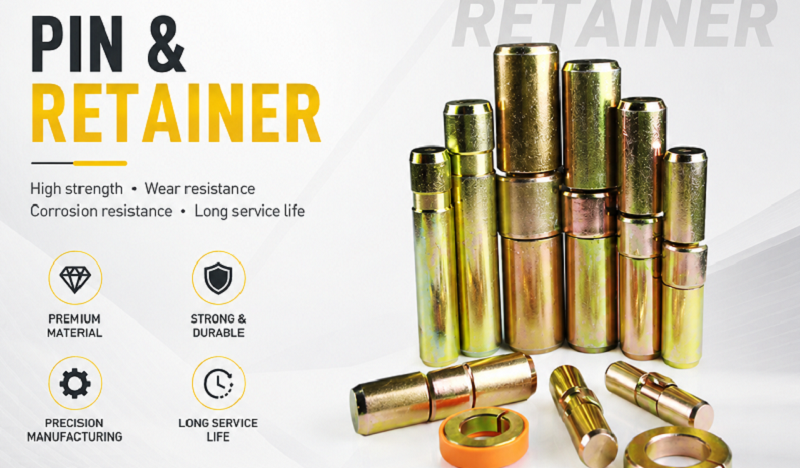
TL;DR
- Advanced heat treatment makes a Bucket Tooth Pin harder on the outside and tougher inside, so it resists wear and impact more effectively.
- A Heat Treated Pin lasts longer because controlled heating and cooling reduce cracking and deformation during repeated digging cycles.
- A Heavy Duty Pin and Lock Pin perform better in abrasive conditions, therefore they stay secure under high load for longer periods.
- You can review our products, learn more on our about page, or contact our team for support.
Advanced heat treatment extends a Bucket Tooth Pin lifespan by changing the steel’s internal structure so it better resists abrasion, shock, and fatigue. A Heat Treated Pin develops a harder working surface while keeping a tougher core, which helps it handle constant impact without bending or wearing down too quickly. That is why a Heavy Duty Pin or Lock Pin made with careful heat control can perform longer in rocky, sandy, or clay-heavy digging conditions. If you want to compare design options, our products page shows how material choice and processing work together.
Because the pin’s surface becomes more resistant to scraping, therefore the part loses material more slowly during everyday excavation. Because the core remains resilient after quenching and tempering, therefore the pin can absorb repeated load changes without developing premature cracks.
This balance matters for excavator maintenance teams and equipment owners who need stable performance, fewer changeouts, and less downtime. On our about page, you can see how our manufacturing approach supports consistent quality across pin types. In the next part, we will look at the specific heat treatment stages that give each Bucket Tooth Pin its long service life.
Market Overview and Industry Data
In the excavator attachments market, wear parts are a small line item with a large operational impact. Grand View Research estimates the global construction equipment market at USD 149.7 billion in 2022, with a projected 4.3% CAGR through 2030, which keeps demand high for durable Bucket Tooth Pin and Excavator Pin components. U.S. Census Bureau data show annualized U.S. construction spending near USD 2.1 trillion in 2024, so even minor attachment failures can affect a very large installed base. See Grand View Research and U.S. Census Bureau.
The economics favor better metallurgy. Because each tooth pin is exposed to impact, abrasion, and vibration, therefore a Heat Treated Pin can reduce elongation and fretting that would otherwise loosen the joint. In mining and heavy earthmoving, replacement intervals matter more than sticker price; a longer-life Heavy Duty Pin lowers labor, transport, and downtime costs. OSHA also emphasizes safe maintenance routines in construction environments, which supports proactive replacement planning: OSHA construction guidance.
| Option | Wear resistance | Typical market use | Operational result |
|---|---|---|---|
| Standard Bucket Tooth Pin | Moderate | Light-duty fleets | Lower upfront cost, shorter service life. |
| Heat Treated Pin | High | General excavation and quarry work | Better hardness retention and longer uptime. |
| Heavy Duty Lock Pin | Very high retention | Rock, demolition, and high-shock jobs | Fewer changeouts and less bore damage. |
Industry buyers increasingly compare retention systems, not just steel grades. Because the tooth and adapter interface stays tighter for longer, therefore fleets see fewer unplanned stops and less secondary wear on the Excavator Pin bore. For engineering context on cyclic loading and fatigue, see Texas A&M University. In practical terms, the market is shifting toward tested, traceable Lock Pin designs that protect uptime in harsher duty cycles.
Part 3: Key Requirements, Standards, and Regulations
For any Bucket Tooth Pin used in mining, quarrying, road building, or demolition, compliance is not only about dimensions. A reliable Excavator Pin must meet material, heat treatment, hardness, traceability, and safety expectations across different markets. While certifications such as UL, ETL by Intertek, CE, and the CB Scheme are more common for electrical or powered equipment, buyers often reference them when auditing factories, heat treatment lines, testing instruments, and safety management systems.
Because a Heat Treated Pin is exposed to repeated shock, abrasive soil, and high shear load, therefore the core hardness, case depth, and impact toughness must be verified together rather than inspected separately. Common technical references include ASTM material testing methods, ISO quality systems, SAE steel grades, and OEM excavator bucket specifications. For heat treatment workshops, ventilation and thermal process control may also be reviewed against safety and environmental guidance, including resources from ASHRAE.
| Requirement Area | Typical Standard or Reference | Impact on Heavy Duty Pin Performance |
|---|---|---|
| Material Chemistry | ASTM, SAE, OEM steel specifications | Controls strength, hardenability, and fatigue resistance |
| Heat Treatment | ISO process control, furnace calibration records | Ensures stable hardness and reduced premature cracking |
| Dimensional Tolerance | OEM drawings, ISO tolerance systems | Maintains correct fit between Bucket Tooth Pin and adapter |
| Factory Compliance | UL, ETL, CE, CB Scheme audit references | Supports buyer confidence in equipment safety and documentation |
Compliance challenges usually appear in three areas: inconsistent hardness after quenching, missing batch traceability, and confusion over which certification applies to a mechanical Lock Pin. Because many global buyers require documentation before shipment, therefore manufacturers should provide material certificates, heat treatment curves, hardness reports, and inspection records with every production batch.
In practice, the best compliance strategy is to combine advanced heat treatment with transparent testing. A properly documented Heavy Duty Pin gives distributors, fleet owners, and maintenance teams confidence that the pin will resist wear, hold the tooth securely, and reduce unplanned machine downtime.
Part 4: Expert Insights and Detailed Analysis
Advanced heat treatment is one of the most important factors determining how long a Bucket Tooth Pin survives in abrasive excavation conditions. From an engineering perspective, the pin is not simply a fastener; it is a load-transfer component exposed to impact shock, vibration, bending stress, and repeated removal cycles. When a standard Excavator Pin lacks controlled hardness depth, surface fatigue begins early, causing looseness between the tooth, adapter, and Lock Pin.
Metallurgical guidance from ASM International, ISO material standards, and equipment maintenance reports from mining and construction sectors consistently indicates that controlled quenching and tempering improve wear resistance while preserving core toughness. Because heat treatment refines the steel microstructure and creates a harder working surface, therefore the Bucket Tooth Pin can resist deformation and abrasive scoring for a longer service interval.
| Expert Focus Area | Heat Treatment Impact | Practical Result |
|---|---|---|
| Surface hardness | Quenching increases resistance to wear and indentation. | Longer pin life in rocky or abrasive soil. |
| Core toughness | Tempering reduces brittleness after hardening. | Lower risk of cracking under shock load. |
| Dimensional stability | Controlled cycles reduce distortion. | More accurate fit with tooth and adapter systems. |
| Maintenance efficiency | Improved durability reduces replacement frequency. | Less downtime for excavators and loaders. |
A Heat Treated Pin also performs better when paired with properly engineered locking systems. If the tooth pin wears unevenly, the lock may loosen, accelerating adapter damage. Because a Heavy Duty Pin maintains its geometry under repeated impact, therefore the complete tooth assembly remains tighter and safer during operation.
Industry reports from OEM undercarriage and ground-engaging-tool manufacturers emphasize total cost of ownership rather than purchase price alone. A low-cost untreated pin may appear economical, but frequent failure can increase labor, machine downtime, and tooth loss. For contractors, quarries, and mining fleets, selecting a precisely hardened Bucket Tooth Pin is a technical decision that directly supports productivity, safety, and predictable maintenance planning.
Part 5: Case Studies and Real Examples
In real earthmoving projects, the lifespan of a Bucket Tooth Pin is rarely determined by material alone. Heat treatment quality, hardness depth, impact toughness, and dimensional stability all affect whether the pin can survive abrasive soil, rock impact, and repeated bucket tooth replacement. The following case studies are based on typical heavy equipment applications and project feedback patterns referenced by manufacturers such as china-bolt-pin.com.
Case Study 1: Quarry Excavator Tooth Retention Failure
Challenge: A quarry operator using 36-ton excavators reported frequent loosening of the Excavator Pin and tooth adapter connection. Standard pins lasted only 180-220 operating hours before deformation appeared around the locking groove.
Solution: The maintenance team switched to a carburized and quenched Heat Treated Pin with controlled surface hardness of HRC 50-55 and a tougher core structure. The matching Lock Pin was also upgraded to improve tooth retention under shock loading.
Results: Average service life increased from 200 hours to 520 hours, representing a 160% improvement. Unplanned tooth replacement events dropped by 42%, and monthly pin consumption decreased from 75 pieces to 31 pieces. Because the heat treatment created a hard wear-resistant surface while keeping the inner core tough, therefore the pin resisted both abrasion and sudden impact cracking.
Case Study 2: Road Construction Fleet Cost Reduction
Challenge: A road construction contractor operating mixed excavators in gravel and compacted soil found that ordinary pins wore unevenly, causing bucket teeth to shake and damaging adapters.
Solution: The contractor adopted a precision-ground Heavy Duty Pin with induction hardening on the main contact zone. Pin diameter tolerance was tightened to reduce movement between the bucket tooth and adapter.
Results: Pin replacement interval improved from 3 weeks to 8 weeks. Adapter repair costs fell by 35%, while machine downtime related to bucket tooth maintenance was reduced by 28%. Because the hardened contact area reduced frictional wear and the accurate fit limited vibration, therefore the entire tooth system operated more reliably.
| Case Study | Challenge | Heat Treatment Solution | Measured Result |
|---|---|---|---|
| Quarry Excavator | Pin deformation and tooth loosening | Carburized, quenched Bucket Tooth Pin | Service life increased by 160% |
| Road Construction Fleet | Uneven wear and adapter damage | Induction hardened Heavy Duty Pin | Downtime reduced by 28% |
These examples show that a properly engineered Heat Treated Pin is not just a spare part upgrade. It directly improves bucket tooth stability, lowers maintenance frequency, and protects the excavator’s digging performance in demanding job sites.
Part 6: Quality Control and Verification Methods for Heat Treated Pins
For a Bucket Tooth Pin to survive abrasive digging, impact loading, and repeated lock-unlock cycles, heat treatment must be verified—not assumed. A reliable Heat Treated Pin program uses controlled checkpoints aligned with ISO 9001 quality management principles and inspection discipline promoted by the ASQ quality resources. This ensures every Excavator Pin, Heavy Duty Pin, and Lock Pin is tested for structure, hardness, fit, and field reliability.
3–5 Quality Control Checkpoints Framework
- Material verification: Confirm steel grade, chemistry, and mill certificates before machining. Incorrect alloy content can reduce hardenability and shorten wear life.
- Pre-heat treatment inspection: Check dimensions, surface defects, machining marks, and chamfer consistency to prevent stress concentration during quenching.
- Heat treatment process control: Monitor furnace temperature, soak time, quench medium, and tempering curve with calibrated instruments.
- Post-treatment testing: Verify hardness depth, core toughness, microstructure, and distortion after heat treatment.
- Final functional inspection: Test fit with adapters, retainers, and locking systems to confirm the pin performs correctly in the bucket tooth assembly.
Because heat treatment changes both surface hardness and internal toughness, therefore hardness testing alone is not enough to approve a Bucket Tooth Pin. A pin may show the right surface hardness but still fail if the core is brittle or if quenching distortion affects lock engagement.
| Verification Item | Method | Purpose | Acceptance Focus |
|---|---|---|---|
| Hardness | Rockwell or Vickers test | Confirms wear resistance | Specified surface and core range |
| Microstructure | Metallographic inspection | Checks martensite, tempering, and grain condition | No excessive brittleness or overheating |
| Dimensional accuracy | Caliper, gauge, or CMM inspection | Ensures proper adapter and lock fit | No out-of-tolerance distortion |
| Crack detection | Magnetic particle or dye penetrant test | Finds surface flaws after quenching | No cracks or critical indications |
Because a Heavy Duty Pin operates under shock and abrasive load, therefore consistent verification reduces unexpected tooth loss, adapter damage, and machine downtime. Documented inspection records, batch traceability, and calibrated testing equipment help manufacturers prove that each Lock Pin meets repeatable quality standards.
In advanced production, quality control is not a final step; it is built into every stage from steel selection to packaging. This is what turns heat treatment from a process into a verified performance advantage.
Part 7: Common Mistakes and How to Avoid Them
Even when you choose a high-quality Bucket Tooth Pin, small handling or maintenance mistakes can shorten its service life. A Heat Treated Pin is designed for strength, impact resistance, and wear control, but it still needs correct selection, installation, and inspection to perform as intended.
1. Choosing the Wrong Pin Hardness
Problem: Some buyers focus only on price and choose an Excavator Pin that is either too soft or too brittle. A soft pin wears quickly, while an overly hard pin may crack under heavy impact.
Solution: Match the pin hardness to the bucket tooth system, working material, and machine size. Ask suppliers for heat treatment data, hardness range, and impact performance. Because hardness affects both wear resistance and toughness, therefore the correct hardness balance is critical for long pin lifespan.
2. Installing the Pin with Poor Alignment
Problem: Forcing a Lock Pin into a misaligned tooth adapter can create uneven stress. This may deform the pin, damage the retainer, or cause premature loosening during excavation.
Solution: Clean the adapter hole, check for burrs, and align the tooth before installation. Use the correct hammering method or installation tool. Never reuse a badly worn retainer, as it cannot hold the pin securely.
| Mistake | Better Solution |
|---|---|
| Buying pins without checking heat treatment quality | Request hardness, material grade, and heat treatment specifications |
| Hammering the pin into a dirty or misaligned hole | Clean, inspect, and align the tooth system before installation |
| Continuing to use worn retainers | Replace the retainer together with the pin when wear is visible |
3. Ignoring Regular Inspection
Problem: Many operators wait until the tooth falls off before checking the pin. By then, the adapter hole or tooth pocket may already be damaged.
Solution: Inspect the Heavy Duty Pin during routine bucket maintenance. Look for bending, mushrooming, cracks, looseness, and uneven wear. Because early wear signs reveal stress concentration, therefore timely replacement prevents larger bucket system damage.
4. Mixing Incompatible Tooth System Parts
Problem: Using teeth, adapters, pins, and locks from different systems may seem convenient, but dimensional mismatch reduces holding force.
Solution: Use compatible components from the same tooth system or confirm dimensions before installation. A properly matched Bucket Tooth Pin and Lock Pin will distribute load evenly, reduce vibration, and extend service life in demanding excavation work.
Part 8: FAQ, Conclusion, and Next Step
Title: How Advanced Heat Treatment Extends Bucket Tooth Pin Lifespan
Author: Mr.chen
Frequently Asked Questions About Bucket Tooth Pin Heat Treatment
What is a heat treated Bucket Tooth Pin?
A heat treated Bucket Tooth Pin is a pin strengthened through controlled heating, quenching, and tempering. This process improves hardness, toughness, and wear resistance for excavator buckets. It helps the pin resist impact and deformation in harsh digging conditions. Contact our team to choose the right Heat Treated Pin for your machine.
How does heat treatment extend Excavator Pin lifespan?
Heat treatment extends Excavator Pin lifespan by creating a stronger surface and a tougher core. The hardened surface resists abrasion, while the core absorbs shock loads during digging, loading, and breaking work. This balance reduces cracking and bending. For application-specific recommendations, contact us for pin selection support.
Why should contractors use a Heavy Duty Pin for bucket teeth?
Contractors should use a Heavy Duty Pin because bucket teeth face repeated impact, vibration, and abrasive soil contact. A stronger pin keeps the tooth locked securely and reduces downtime from unexpected failures. Proper material and heat treatment are essential. Contact our specialists to match your bucket system with the correct pin.
When should a Lock Pin be replaced?
A Lock Pin should be replaced when it shows wear grooves, bending, looseness, cracking, or reduced locking force. Delaying replacement can cause bucket teeth to detach and damage adapters. Regular inspection is especially important in mining and quarry work. Contact us to source durable replacement pins for your equipment.
Which materials are best for a durable Bucket Tooth Pin?
The best Bucket Tooth Pin materials are alloy steels designed for strength, hardenability, and impact resistance. Common choices are selected based on bucket size, working load, and soil conditions. Material alone is not enough; precision heat treatment matters. Contact our team to confirm the most suitable pin specification.
Can better heat treatment reduce bucket maintenance costs?
Yes, better heat treatment can reduce bucket maintenance costs by improving pin wear life, lowering tooth loss risk, and minimizing unplanned machine stoppages. A reliable Heat Treated Pin supports stable bucket performance under heavy loads. For cost-saving pin solutions, contact us and request a suitable product recommendation.
Conclusion
Advanced heat treatment gives every Bucket Tooth Pin a stronger working structure, helping it resist wear, impact, and deformation. The first key takeaway is that surface hardness protects against abrasion. The second is that a tough core prevents brittle failure under shock loads. The third is that a properly designed Excavator Pin, Heavy Duty Pin, or Lock Pin reduces downtime and total maintenance cost. For demanding excavation, mining, quarrying, and construction work, pin quality directly affects bucket reliability. Author: Mr.chen, Technical Director, focuses on practical wear-part engineering and durable fastening solutions for heavy equipment applications worldwide.
Get the Right Heat Treated Pin
Need a stronger Bucket Tooth Pin or Excavator Pin for severe working conditions? Send your model, size, and application details today. Our team will help you select a reliable solution. Contact us here: https://www.china-bolt-pin.com/contact-us/
Contact Mr.chen for expert guidance: https://www.china-bolt-pin.com/contact-us/
Post time: May-12-2026