- Cutting edge bolt MOQ pricing typically runs in three tiers: 500 units (highest unit cost), 1,000–2,000 units (mid), and 3,000–5,000 units (lowest unit cost).
- The per-unit price gap between 500 and 5,000 units can be substantial — but total landed cost depends on inventory carrying cost, not just unit price.
- The real MOQ variable is not just quantity — it is the number of unique part numbers in the order. Consolidating SKUs cuts the effective MOQ per SKU.
- A factory with ISO 9001, in-house heat treatment, and hardness testing can hold grade tolerances that a trading broker cannot.
The Price Cliff Nobody Warns You About
A procurement manager at an open-cut iron ore operation in West Africa was reviewing three supplier quotes for the rainy season shutdown. The lowest quote was 18 % below the other two — a gap that looked like a straightforward win on the spreadsheet. Eight months later the site had replaced that batch of 4F3656 plow bolts twice. The real cost of the 18 % saving was four times the original price difference in unscheduled downtime and loader downtime hours.
The cutting edge bolt wholesale market does not always reward the lowest unit price. The gap between a credible factory quote and a broker price is real, and it shows up in torque retention, in crack resistance after heat treatment, and in the thread consistency that determines whether a bolt makes it onto the machine or into the scrap bin. This article is about reading those quotes correctly, understanding what the MOQ tiers actually mean for your total cost, and knowing what questions to ask before you sign the purchase order.
What Makes a Bolt “Mine-Grade”
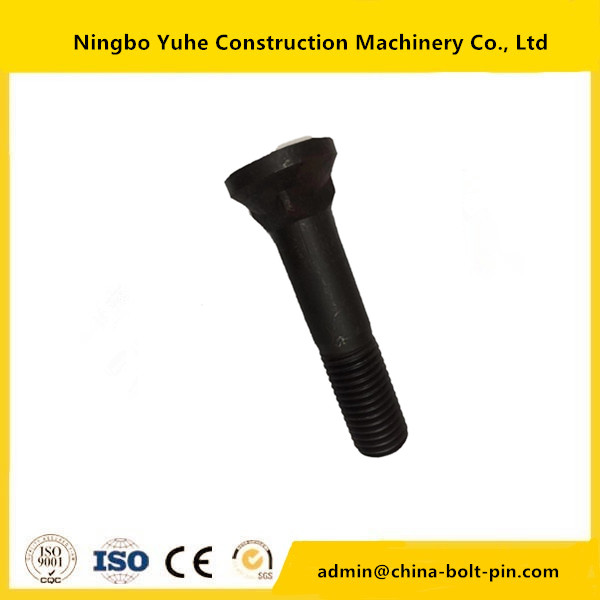
A cutting edge bolt — also called a plow bolt or a segment bolt — holds the cutting edge or ground engaging tool (GET) onto the base edge of a dozer blade, loader bucket, or scraper blade. The bolt is loaded in shear and tension simultaneously every time the edge contacts rock or overburden. A bolt that fails in shear fatigue leaves the GET loose; a bolt that fails in tension leaves a hole in the cutting edge that requires welding to repair.
Mine-grade means the bolt has been manufactured and tested to hold those loads reliably in high-impact, high-abrasion service. Three material and process factors determine whether a bolt is genuinely mine-grade:
- Core tensile strength. The bolt body must meet a minimum tensile strength after heat treatment. For metric cutting edge bolts the governing standard is ISO 898-1, which defines property classes such as 8.8, 10.9, and 12.9. The 12.9 class (tensile ≥ 1,200 MPa) is the most common specification for mine-grade plow bolts.
- Core hardness after heat treatment. The heat treatment process — quench-and-temper — must bring the core hardness into the correct range for the grade. Hardness that is too low means the threads strip under tightening torque; hardness that is too high makes the bolt brittle and susceptible to impact fracture. Hardness testing with a Brinell or Rockwell tester on every heat treat batch is the mark of a factory that knows what it is doing.
- Case hardness for wear resistance. For bolts used in high-abrasion environments, the surface may be induction-hardened to create a wear-resistant case while the core remains tough. A 12.9 bolt with a properly applied case-hardened surface can outlast a plain 12.9 bolt in severe abrasion applications by a significant margin.
The Three MOQ Tiers: What Changes Between 500 and 5,000 Units
Most cutting edge bolt factories set minimum order quantities in three ranges. The tiers exist because the cost of setting up a press, heat treatment batch, and quality inspection run does not scale linearly with order size. Here is how the tiers typically break down, and what the real trade-off is at each level.
Tier 1 — 500 to 999 Units: The Pilot Tier
The 500-unit MOQ is the entry point for most factories. At this level the setup cost per unit is highest because the factory is recovering the cost of die setup, heat treatment furnace loading, and the first article inspection across a relatively small quantity. Unit price is at its highest, but this is the right tier for a first order from a new supplier. The buyer gets a production-run sample at scale prices, and the factory gets a real order to validate process capability against.
The practical reason to accept the Tier 1 price is that 500 units of a verified bolt will typically cover a full wet season or a single major shutdown cycle for a medium fleet. If the bolts pass the incoming inspection and perform on the machine, the buyer has a validated SKU and can commit to a larger quantity in the next order.
Tier 2 — 1,000 to 2,999 Units: The Standard Project Tier
At 1,000 units the factory can amortise the setup cost across twice as many units, and the heat treatment furnace loading becomes more efficient. The unit price step-down from Tier 1 to Tier 2 is typically the largest single jump in the three-tier structure. For a buyer running a fleet of 20–50 machines this is the natural order size: it covers the annual consumption of the most common cutting edge bolt SKUs and gives the factory enough quantity to run the bolts as a dedicated production batch rather than a mixed SKU run.
The key variable at this tier is the number of unique part numbers. An order of 1,500 units across three SKUs (500 each) behaves like three separate Tier 1 runs in terms of per-unit cost — the factory still had to set up three different dies and three separate heat treatment loads. The buyer who consolidates to a single or dual-SKU order at 1,000–2,000 units gets the real Tier 2 benefit.
Tier 3 — 3,000 to 5,000+ Units: The Annual Contract Tier
A 3,000-to-5,000-unit order is typically what a factory calls an annual contract quantity or a dedicated-production-run quantity. At this level the factory can schedule the bolts as a single production campaign, the heat treatment furnace runs at full load, and the per-unit cost is at its floor for that SKU. Some factories offer a further step-down at 5,000 units and above.
The real calculation at Tier 3 is not just unit price — it is inventory carrying cost. A buyer who orders 5,000 bolts at a 12 % lower unit price but then holds 60 % of that inventory for 14 months before use has not necessarily saved money. The Association of Equipment Manufacturers (AEM) publishes guidance on inventory optimization for heavy equipment components that applies directly to cutting edge bolt procurement strategy.
What Drives the Price Gap Between Factories
Two factories quoting the same part number at the same MOQ can produce quotes that differ by more than 20 %. That gap is not arbitrary — it reflects differences in manufacturing process, quality system, and the way the factory handles raw material and heat treatment.
Raw material traceability
A factory that purchases ISO 898-1-certified bar stock from a named mill can provide a material test report (MTR) for each heat. A factory that buys commodity bar from a distributor on price alone cannot trace the material back to a specific heat, which means the buyer cannot verify that the boron content — which is what gives a 10.9 or 12.9 bolt its strength — is within the correct range. Traceability is not an optional extra; it is the document that proves the bolt met the spec.
In-house heat treatment versus subcontracted heat treatment
Heat treatment is the most critical and most commonly subcontracted process in fastener manufacturing. A factory that sends its bolts out for heat treatment loses direct control of quench timing, tempering temperature, and load density in the furnace. A factory with in-house heat treatment can adjust the process on the day based on the batch, run sample hardness checks between loads, and hold the process within tolerance across the entire run. The difference shows up in the consistency of the hardness reading from the first bolt to the last bolt in a production batch.
Quality system and inspection protocol
An ISO 9001-certified factory is required to maintain documented inspection procedures, calibration records for measurement equipment, and a non-conforming product control process. That certification is not a guarantee of perfect product — it is a guarantee that the factory has a system for catching deviations and controlling them. Buyers who work with non-certified factories or brokers frequently discover that the inspection protocol was defined by the buyer, not by the factory, which means there is no independent quality system running underneath the order.
When you review a factory’s ISO 9001 certificate look for the scope statement: it should cover the manufacturing and testing of fasteners or mechanical components. A certificate with a scope that covers “general metal fabrication” and nothing specific about fastener testing is a red flag.
The Hidden Cost That Is Not on the Quote
The true cost of a cutting edge bolt in mine service is not the landed unit price — it is the cost of the event if the bolt fails. A failed bolt in a cutting edge assembly causes one or more of the following: GET loss (the tooth or segment comes off and must be retrieved from the muck pile), base edge damage (a loose GET grinds against the cutting edge surface, requiring re-machining or weld repair), and machine downtime (the loader or dozer stops for an unplanned change-out).
In a large open-cut operation, one hour of unplanned loader downtime can cost in the low three-figure range per hour. A bolt that retightens correctly on the first installation and holds through the full shift cycle costs less per hour of service than a bolt that backs out after 40 hours and requires a second change-out. Buying on unit price alone without reference to the failure cost on the machine is how buyers end up with the lowest quoted price and the highest total cost of operation.
The torque retention test you can run in 10 minutes
When the bolts arrive, run a torque retention check before fitting them to the machine. Bolt a sample set into a steel test fixture or the machine itself and torque to specification. After 30 minutes, re-torque to the same specification without removing the bolt. If the bolt turns more than half a turn on the second torque pass, the thread friction coefficient or the clamp load retention is below spec. That batch should not go on the machine — return it and ask for a test report covering torque coefficient and proof load.
Reading a Cutting Edge Bolt Quote: What to Verify Before You Order
A cutting edge bolt quote that looks complete on the surface often omits the information that determines whether the bolts will perform. Here are five fields that must be on a credible quote, and what each one tells you.
- Part number and geometry standard. The quote must name a specific part number (e.g. 4F3656, 3F5108, 4F3665) or a geometry drawing. “Cutting edge bolt” is not a specification — two factories quoting the same part number may be quoting two completely different thread forms or head styles if they are using different manufacturer standards (CAT spec versus Komatsu spec versus ISO metric).
- Property class or tensile strength. The quote must state the property class (8.8, 10.9, 12.9) or the minimum tensile and yield strength in MPa. For a mine-grade bolt this should be 12.9 or equivalent.
- Heat treatment method. The quote should state whether heat treatment is performed in-house or subcontracted, and provide the heat number and hardness test result for the batch.
- Inspection and test report. The quote should include a dimensional inspection report and a torque or proof load test report for the specific order quantity.
- MOQ per SKU and total MOQ for the order. The quote must distinguish between the MOQ per individual part number and the total order quantity. A quote of “MOQ 500″ without specifying per SKU can mean the factory requires 500 units total across all SKUs, or 500 units per SKU — a critical difference if you are ordering four different part numbers.
How to Structure Your First Order from a New Cutting Edge Bolt Supplier
The safest first order structure with a new supplier is a split order: 500 units of the primary SKU as a Tier 1 pilot, plus 500 units of a second or third commonly-used SKU at the same tier. This gives the factory two dedicated setup runs (which is better than one mixed run) and gives the buyer two SKUs to evaluate independently before committing to a Tier 2 or Tier 3 quantity on either SKU.
Before placing the first order, ask the factory for the following: a sample kit of two to five bolts from the production line (not from a prototype die), a current ISO 9001 certificate, and a material test report for the specific heat number that will be used for the production run. A factory that can deliver all three before the order is confirmed is operating a genuine production system. A factory that offers a样品 without documentation, or asks you to place the order first and receive documentation with the shipment, is a trading operation without in-house process control.
Cutting Edge Bolts and the Global Sourcing Picture
Cutting edge bolt wholesale procurement sits at the intersection of wear-parts logistics and precision fastener sourcing. Buyers in North America, Australia, Sub-Saharan Africa, Southeast Asia, and Latin America all source from the same manufacturing bases — primarily China for metric cutting edge bolts and the United States for CAT-spec and Komatsu-spec aftermarket bolts.
For buyers in ASEAN and the Middle East, the US Harmonized Tariff Schedule (HTS) classification of cutting edge bolts (typically under HTS 7318.15 or 7318.16 depending on thread type and grade) determines the applicable import duty. Buyers in markets with preferential duty rates under free trade agreements should verify that the factory can provide a certificate of origin for the relevant agreement before the commercial invoice is issued.
The global aftermarket for CAT, Komatsu, Volvo, and Hitachi excavator and dozer wear parts is served primarily by three types of supplier: original equipment manufacturer (OEM) parts channels, independent aftermarket (IAM) manufacturers, and trading operations that source from multiple factories. The IAM manufacturers — factories that produce to OEM equivalent or better specifications without using OEM trademarks — offer the best cost-performance ratio for buyers who can verify the manufacturing specification independently. For a broader view of how global distributors evaluate mine-grade cutting edge bolt sourcing across multiple markets, see the Global Distributors Guide. The plow bolt product category page on China-Bolt-Pin.com covers the range of metric and imperial cutting edge bolt types available from one such manufacturer.
FAQ: Cutting Edge Bolt Wholesale MOQ and Pricing
Why do cutting edge bolt factories set MOQs at 500 units?
Is a lower MOQ always better for the buyer?
What is the typical price difference between 500 and 5,000 units?
How do I verify that a cutting edge bolt is genuinely 12.9 grade?
Can I order multiple part numbers at the same time to reach a higher MOQ tier?
What is the biggest mistake buyers make when sourcing cutting edge bolts internationally?
How does ISO 9001 certification protect the buyer?
Need a quote for cutting edge bolts or metric plow bolts? China-Bolt-Pin.com supplies mines, distributors, and equipment dealers worldwide.
Post time: Sep-17-2026