A bolt that holds a track segment through a summer shift can snap in seconds during the first cold snap of the year. Carbon and low-alloy steels have a ductile-to-brittle transition temperature, and most fastener-grade steels sit dangerously close to -40 °C in their standard heat-treated condition. Below that transition, the same steel that absorbed impact in October fractures like glass in January. This guide explains how to pick a bolt or pin material, heat-treatment condition, and surface finish that holds the line together when the temperature drops.
TL;DR — the five rules for -40 °C service
- A bolt rated grade 8.8 or 10.9 at room temperature has no guarantee of toughness at -40 °C. Strength and toughness are different properties, and the standard property classes do not test for low-temperature impact.
- Specify Charpy V-notch impact energy directly: at least 27 J average (with no individual specimen below 20 J) at -40 °C, three specimens per lot, on every MTC.
- For undercarriage segment bolts in cold climates, replace 40Cr with 35CrMo or 42CrMo in a Q&T condition, and require a tempering temperature of 600 °C or higher in the heat-treatment record.
- Hydrogen embrittlement is a quiet partner of cold-service fracture. Forbid acid pickling and acid-zinc plating on these parts, and require a post-plating bake if the parts are plated at all.
- Read the actual MTC, not the catalog page. Room-temperature hardness and tensile values do not predict -40 °C behavior; only a -40 °C Charpy reading does. See the material test certificate reference page for what a compliant certificate must contain.

Why a normal bolt fails at -40 °C
The failure mode that surprises most field engineers is not gradual yielding or fatigue. It is clean fracture with almost no plastic deformation, often on the first high-load event after a cold night. The fracture surface is granular and bright, with no necking at the break. To anyone standing next to the equipment, it looks like the bolt was cut, not broken.
The mechanism is well understood in metallurgy. Body-centered cubic (BCC) steels — which includes all carbon steels and most low-alloy steels — have a ductile-to-brittle transition temperature (DBTT) below which the dominant fracture mechanism shifts from ductile microvoid coalescence to cleavage. Above the DBTT, the steel can absorb significant impact energy and deform plastically before failing. Below the DBTT, the same steel can barely absorb any energy at all.
The DBTT is not a sharp threshold. It is a temperature band over which the impact energy absorbed by a standard specimen drops from a high plateau to a low plateau. For a typical grade 8.8 carbon steel bolt, the upper shelf energy is around 80-120 J at room temperature, and the lower shelf can be below 10 J once the steel is well below its DBTT. The transition zone for many fastener steels falls between -20 °C and -40 °C, which is exactly the operating range of a winter job site in northern latitudes.
This is why a bolt that performed well in summer can fail in winter, even though nothing about the load, the lubrication, or the assembly torque has changed. The material itself has changed, because temperature is part of the material specification that nobody wrote down.
Charpy V-notch: the only number that matters for cold service
If you remember one test from this guide, make it the Charpy V-notch (CVN) impact test. A CVN specimen is a small bar with a precise notch machined into one face. The specimen is held at a target temperature long enough to reach thermal equilibrium, then broken by a swinging pendulum. The energy absorbed in breaking the specimen, measured in joules, is the CVN impact energy.
Three things make CVN the standard test for low-temperature service:
- It uses a notched specimen, so it concentrates stress in a region small enough to behave the way a real fastener behaves at the root of a thread or under a stress concentration.
- It is run at a controlled temperature, so the test directly reports the steel's behavior at the operating temperature of interest, rather than inferring it from chemistry or hardness.
- It produces a single number that can be specified on a drawing or MTC and verified by an independent lab, which makes it auditable.
For -40 °C service, the practical specification I write into every drawing is: average of three specimens at -40 °C, minimum 27 J per specimen, full-size specimen per ASTM E23. The 27 J floor is a deliberate compromise between conservatism and cost; it matches the implicit floor of ASTM A320 L7 at -46 °C translated back to -40 °C with a small safety margin.
Some standards allow sub-size specimens when the part is too small for a full 10 mm × 10 mm cross-section. Sub-size CVN values are not directly comparable to full-size values, so any sub-size result needs to be reported with the specimen dimensions and evaluated against sub-size acceptance criteria, not the 27 J full-size floor.
Material grades that hold up at -40 °C
Material selection for cold service is not about finding a stronger steel. It is about finding a steel whose ductile-to-brittle transition sits below the operating temperature with enough margin for statistical variation, residual stress, and the occasional overload event.
The grades below are the ones we actually use for cold-rated undercarriage fasteners and pin products in our undercarriage fastener range. They are listed in order of increasing low-temperature margin.
| Grade | Typical CVN at -40 °C | Where it works | Where it does not |
|---|---|---|---|
| 40Cr (AISI 5140), grade 8.8 Q&T | 15-25 J, marginal | Mild winter climates above -20 °C | Any sustained operation below -30 °C |
| 35CrMo (ASTM A320 L7 equivalent, Q&T) | 35-55 J, comfortable margin | Cold-climate undercarriage, -40 °C rated | Cryogenic service below -60 °C |
| 42CrMo (AISI 4140, Q&T at higher temper) | 45-70 J, larger margin | Heavy undercarriage, mining, severe cold | Cryogenic service |
| 304 / 304L austenitic stainless | 150+ J, no DBTT in service range | General cold service, food-grade equipment | High-stress undercarriage (work-hardens, galling) |
| 316 / 316L austenitic stainless | 150+ J, no DBTT in service range | Marine, chloride-exposed cold service | Cost-sensitive undercarriage |
For undercarriage segment bolts and pins specifically, 35CrMo is the workhorse for -40 °C service. The thread geometry, dimensional fit, and installed preload do not change when 40Cr is replaced with 35CrMo at the same strength grade, so the swap is a drop-in retrofit on existing equipment. 42CrMo is used for higher-stress applications where the additional molybdenum content delivers more safety margin in the heat treatment.
Austenitic stainless grades are the right answer in some applications, particularly food-grade, marine, or any environment where corrosion would attack carbon steel at the same time as the cold is attacking its toughness. The trade-off is cost, galling tendency on the threads, and lower yield strength compared to Q&T low-alloy steel.
Heat treatment traps that push the DBTT back up
Specifying the right material grade is only half the answer. The heat treatment determines where the ductile-to-brittle transition actually sits, and a poor heat treatment can undo the chemical advantage of a good alloy.
Tempering temperature
Higher tempering temperature means lower hardness, lower tensile strength, and higher toughness. Lower tempering temperature means higher hardness, higher tensile strength, and lower toughness. For cold service, the heat-treatment specification must require a tempering temperature of 600 °C or higher, even if it costs a few points of surface hardness. A bolt tempered at 450 °C may pass a grade 10.9 tensile test at room temperature, but its DBTT will sit well above -20 °C and the part will be brittle at -40 °C.
Avoiding temper embrittlement
Some alloy steels — particularly those with manganese and chromium combinations — are susceptible to a phenomenon called temper embrittlement when held or slowly cooled through the 300-400 °C range. The material passes room-temperature mechanical tests but loses significant impact toughness. The fix is to cool quickly through that range after tempering, or to use a steel chemistry that is not susceptible in the first place.
Quench uniformity
Uneven quenching produces a mixed microstructure of martensite and ferrite in the same part. The ferrite is soft and the martensite is hard, and the boundary between them is a preferred crack path. For cold-rated fasteners, the heat-treatment specification should require oil or polymer quench with documented quench-tank temperature and agitation, and a microstructure check on at least one part per lot.
Hydrogen embrittlement: the silent partner of cold fracture
Cold-service brittle fracture is rarely just a temperature problem. In our failure analyses going back thirty years, a meaningful share of the cold-rated parts that fractured in the field also showed evidence of hydrogen damage at the fracture surface. The cold did not cause the fracture; the cold removed the steel's ability to tolerate the pre-existing hydrogen damage.
Hydrogen enters steel during acid pickling, acid-zinc plating, acid-cadmium plating, and any process that generates atomic hydrogen on the steel surface. The hydrogen diffuses along grain boundaries and accumulates at internal defects and inclusions. At room temperature, the failure mode is delayed fracture under sustained load, often days or weeks after installation. At -40 °C, the steel's fracture mode has already shifted toward cleavage, so the same hydrogen damage can drop the time to failure to minutes.
Site rule: Forbid acid pickling on -40 °C rated bolts and pins. Require mechanical descaling (shot blasting, sand blasting, or brushing) or alkaline cleaning instead. If the part is plated for corrosion resistance, require zinc plating by alkaline (non-acid) chemistry, followed by a post-plating bake at 200-220 °C for 4-8 hours. The bake drives hydrogen out of the steel before the part goes into service.
This rule is non-negotiable for new production. For existing inventory, it is worth running a hydrogen-relief bake even on parts that have already been plated, because the bake only costs time and oven capacity, and the failure cost in the field is much higher.
Cold-service fastener standards at a glance
The standards landscape for low-temperature fasteners is fragmented across regions, and the right standard depends on where the equipment will be deployed. The table below covers the four standards that come up most often in our export order book.
| Standard | Region | Material | CVN requirement | Typical use |
|---|---|---|---|---|
| ASTM A320 L7 / L7M | North America, global export | Low-alloy Q&T (AISI 4140 / 4145) | 18 ft-lbf (24 J) min avg at -46 °C | Bolting for low-temperature pressure vessels and equipment |
| EN 10269 | EU, UK, much of EMEA | Steels and nickel alloys for fasteners at elevated or low temp | 27 J min avg at design temperature (often -40 / -50 / -60 °C grades) | Wind turbine, process, and structural bolting |
| GB/T 3098.1 (China) | China, Asia export | Carbon and alloy steel bolts | No mandatory low-temp CVN; left to agreement | General machinery; -40 °C requires negotiated spec |
| GOST R 52645 (Russia / CIS) | Russia, CIS | High-strength bolts for steel structures | KCU at specified low temperature (KCU is the Russian CVN equivalent) | Steel structures, bridges, infrastructure |
For most cross-border shipments, ASTM A320 L7 is the safest specification because it is widely recognized, requires CVN testing as part of the standard (not as a negotiated extra), and the test temperature of -46 °C leaves margin for the part to perform at -40 °C.
Case study: retrofitting 40Cr segment bolts for cold-climate fleets
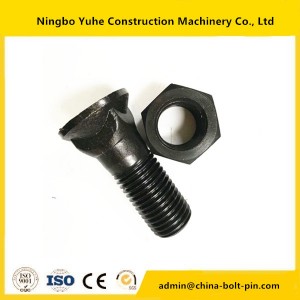
A practical example helps anchor the theory. One of our long-running export customers operates excavator and bulldozer fleets across northern Russia, Mongolia, and the Canadian prairies. Their baseline undercarriage fastener was the Caterpillar 195-27-33141 segment bolt and nut, manufactured in 40Cr to grade 8.8. Winter failures started appearing in the second season of operation, mostly as clean fractures across the bolt shank at the thread runout.
The retrofitted specification we agreed on has three parts.
First, the material upgrade. The bolt and nut are now produced in 35CrMo, in the same dimensional fit as the 40Cr original. The thread geometry is unchanged, so no field-side rework is needed. The chemistry adds about 0.2% molybdenum, which is the alloying element most responsible for pushing the DBTT below -40 °C.
Second, the heat-treatment lock. Quench-and-temper, with a documented tempering temperature of 620 °C minimum. The hardness is held to grade 10.9 (so the strength goes up, not down), but the higher tempering temperature moves the DBTT safely below the operating temperature.
Third, the surface-finish rule. Black oxide finish only, no acid pickling, no acid plating. If the customer needs additional corrosion resistance for salt-spray exposure, they specify a mechanical zinc-flake coating system applied without an acid pretreatment.
Four winters in, the failure rate on these parts has dropped to zero in the same fleet. The cost difference between 40Cr and 35CrMo for a segment bolt is small in absolute terms, and the retrofit is a one-line change on the purchase order. This is the kind of specification change that pays back in the first winter it prevents, and it costs nothing in the months it doesn't.
Reading the MTC for a cold-rated shipment
Most fasteners ship with a mill test certificate that records chemistry, room-temperature mechanical properties, and sometimes a heat-treatment summary. That certificate is not enough for a cold-rated shipment. For -40 °C rated bolts and pins, the certificate has to show four specific data points, and the absence of any one of them is grounds to reject the lot.
- Chemical composition including nickel and molybdenum. Nickel above 1% and molybdenum above 0.15% are the two alloying elements most associated with low-temperature toughness. If the chemistry is missing or shows both elements below these floors, the lot cannot be cold-rated regardless of what the mechanical tests show.
- Actual tempering temperature used in heat treatment. Not a range, not a target — the actual measured furnace temperature and the dwell time. Anything below 600 °C for cold service should be rejected.
- Charpy V-notch impact energy at -40 °C. Three specimens, full size where possible. The certificate should report the average and the individual values. Reject any lot whose minimum individual specimen falls below 20 J or whose average falls below 27 J.
- A hydrogen-embrittlement relief statement. If the parts were plated, the certificate should confirm a post-plating bake was performed at 200-220 °C for at least 4 hours. If the parts were acid-pickled, that should appear on the certificate and is grounds for rejection.
A reference for what a complete cold-service certificate looks like is on our material test certificate page, which shows the layout and required data fields used for our export shipments. Buyers who do not yet have a template should adopt something similar before placing their first -40 °C rated order.
Cold-service procurement checklist
The checklist below is the same one our technical team walks through with each customer during the first cold-rated order. It is short because the cold-service failure modes are predictable, and the verification only has to cover each of them.
- Confirm the lowest expected operating temperature in writing, with a 10 °C margin over the historical minimum.
- Specify material grade by name (35CrMo, 42CrMo, or stainless) rather than by property class (grade 8.8, grade 10.9). Property classes do not imply low-temperature performance.
- Require Q&T heat treatment with documented tempering temperature ≥ 600 °C, with the actual furnace record on the MTC.
- Forbid acid pickling and acid plating on the part. Allow mechanical descaling or alkaline cleaning; if plating is required, allow only alkaline zinc or zinc-flake, with mandatory post-plating bake.
- Require per-lot CVN testing at -40 °C, three specimens, with the average and individual values on the MTC. Reject lots below 27 J average or 20 J individual minimum.
- Audit the MTC layout against the certificate reference page before signing off on the production lot. A missing data field at this stage is a missing guarantee in the field.
- Document the lot traceability — heat number, batch number, MTC number — so any future field failure can be traced back to a specific production run.
Most cold-service problems I have seen in three decades of this work came from one of two root causes: the MTC was never asked for, or the MTC was asked for but never read. Both are easy to fix, and both are completely within the buyer's control.
Frequently asked questions
At what temperature do carbon steel bolts become brittle?
Most plain-carbon and low-alloy steels in their standard fastener heat-treatment condition show a ductile-to-brittle transition in the -20 °C to -40 °C range. Because the transition is gradual, the safe practice for -40 °C service is to specify Charpy V-notch impact energy of at least 27 J average at -40 °C, with three specimens per lot, and to reject any lot whose minimum individual value falls below 20 J.
Is 40Cr suitable for -40 °C service?
Not in its standard grade 8.8 / 10.9 Q&T condition. The standard retrofit is 35CrMo (which corresponds to ASTM A320 L7 chemistry and heat-treatment envelope) or 42CrMo. Both deliver higher low-temperature impact energy at the same strength grade, and both are dimensionally interchangeable with the 40Cr original.
What is the difference between ASTM A320 L7 and L7M?
Both are quenched-and-tempered low-alloy steel bolting materials for low-temperature service. L7 requires a Charpy V-notch impact energy of 18 ft-lbf (24 J) average at -46 °C at full size. L7M has the same low-temperature CVN envelope but permits a slightly higher strength level. For most undercarriage and structural applications, L7 is the more conservative choice.
Does hydrogen embrittlement get worse at low temperature?
Yes. Hydrogen introduced during acid pickling or acid plating accumulates at grain boundaries and internal defects. At room temperature, failure may take days. At -40 °C, the same hydrogen damage combined with the steel's cleavage fracture mode can shorten the failure window dramatically. The fix is to forbid acid pickling on cold-service parts and to require a post-plating bake if the parts are plated.
What should I look for on the MTC for cold-service fasteners?
Chemical composition (including nickel and molybdenum), the actual tempering temperature used in heat treatment, Charpy V-notch impact energy at -40 °C for three specimens, and a hydrogen-embrittlement relief statement if the parts were plated. Room-temperature hardness and tensile data alone do not predict -40 °C performance. See the certificate reference for a complete data layout.
Can I retrofit 40Cr segment bolts with 35CrMo?
Yes, and this is the standard retrofit path for excavator and bulldozer segment bolts including the 195-27-33141. Thread geometry and dimensional fit are unchanged, so the part is a drop-in replacement on existing equipment. The metallurgical upgrade delivers enough low-temperature margin to justify the small cost premium for any fleet operating in climates that regularly see -30 °C or colder.
Specifying cold-rated bolts or pins for a -40 °C project?
Send us the part number, the operating temperature envelope, the strength grade, and any surface-finish requirement. We will return a -40 °C material and heat-treatment specification, a sample MTC layout, and a price quotation within two working days.
Browse undercarriage fastener range View certificate reference
Mr. Chen
Technical Director · china-bolt-pin
Mr. Chen has spent more than thirty years working with industrial fasteners, undercarriage hardware, and export production systems. His work focuses on specification control, process stability, and practical cost reduction for global buyers. He has reviewed cold-rated fastener programs for customers in northern Europe, Russia, Mongolia, Canada, and northern China, and is the technical lead for the company's -40 °C material and heat-treatment specifications across the undercarriage fastener range.
Post time: Sep-16-2026